


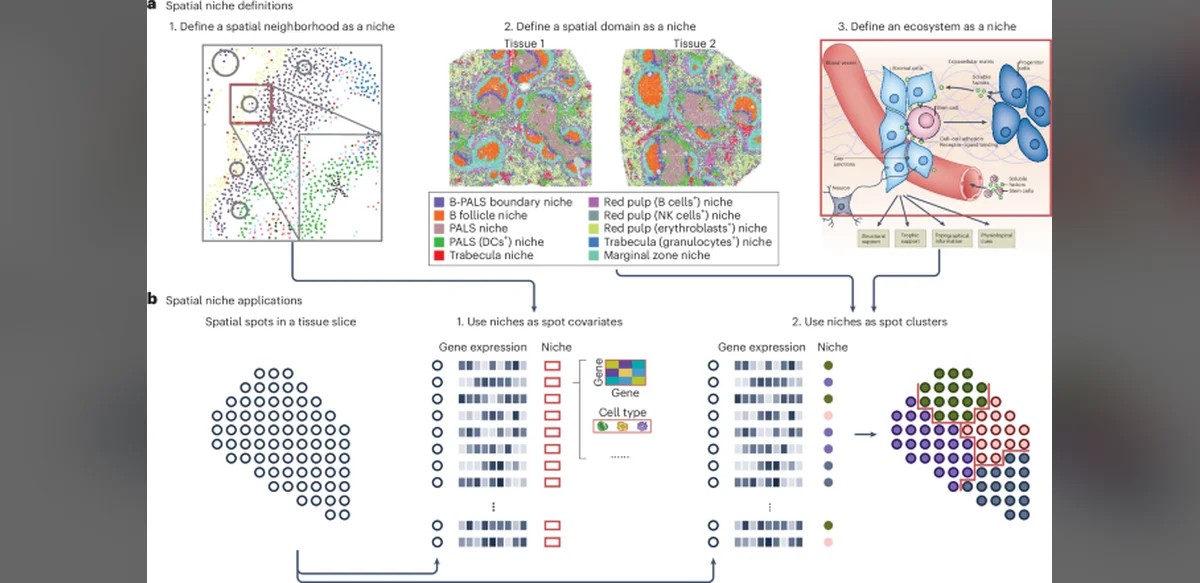
A new perspective published in Nature Genetics addresses the terminology surrounding spatial niches in the growing field of spatial omics. The work focuses on bringing greater consistency to how researchers describe and examine localized biological environments within tissue samples.
Spatial omics techniques enable detailed mapping of molecular features while preserving information about their positions in cells and tissues. This capability has opened new avenues for understanding complex biological processes that depend on location and proximity.
The perspective distinguishes several related but separate concepts. Neighborhoods refer to small-scale groupings of cells that interact closely. Domains represent larger regions with shared molecular characteristics. Biological ecosystems encompass broader systems that include multiple interacting components and dynamic relationships.
By separating these definitions, the authors aim to reduce ambiguity that can arise when different studies use similar terms in varying ways. Clear distinctions support more precise communication across research groups.
The perspective also supplies a decision framework intended to assist scientists in selecting suitable definitions for their specific questions. This framework considers factors such as the scale of analysis, the type of data available, and the biological questions being addressed.
Choosing the right definition influences which computational tools and statistical methods are applied. The framework encourages researchers to match their analytical approach to the chosen spatial concept, thereby improving the reliability of findings.
The discussion highlights how standardized language can accelerate progress in spatial omics. When terms are used consistently, comparisons between studies become more straightforward and cumulative knowledge builds more effectively.
Overall, the perspective contributes to the maturation of spatial omics as a discipline by promoting conceptual clarity. It provides practical guidance without prescribing a single correct approach, recognizing that different research contexts may require different choices.
Continued development of spatial technologies is expected to generate increasingly rich datasets. Frameworks that help organize and interpret these data will remain valuable as the field advances.
The emphasis on clear definitions and decision support reflects broader trends in biomedical research toward greater reproducibility and transparency. Such efforts support the integration of spatial omics findings into larger biological understanding.

