


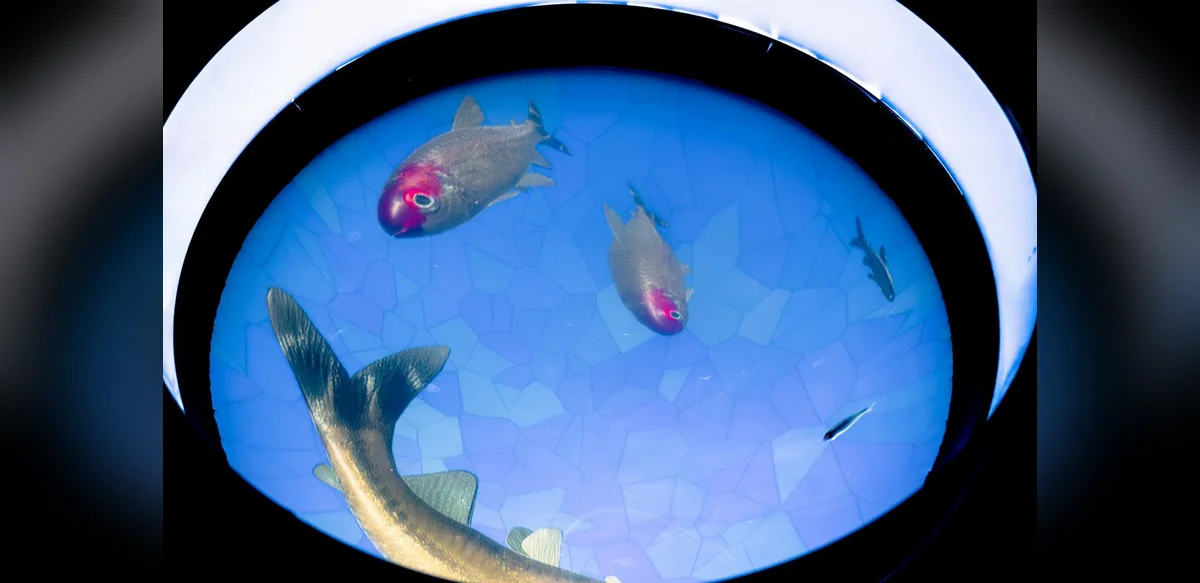
Recent experiments involving real and virtual fish have provided new insights into how groups of aquatic animals maintain coordinated movement. Researchers focused on rummy-nose tetra fish, a species known for schooling behavior in natural habitats. By creating controlled virtual reality setups, scientists observed how individual fish respond to others in their vicinity.
The core finding indicates that each fish does not monitor every member of the group equally. Instead, attention is directed primarily toward a single influential neighbor. This selective focus appears sufficient for maintaining overall group cohesion and synchronized swimming patterns. The use of virtual counterparts allowed precise manipulation of visual cues without altering the physical environment for the real fish.
Schooling in fish has long been studied as an example of collective animal behavior. Traditional models often assumed that individuals integrate information from multiple nearby companions simultaneously. However, the current observations challenge that assumption by demonstrating a more streamlined mechanism. One dominant neighbor provides the necessary directional and speed information, reducing cognitive load while preserving effective group dynamics.
The methodology combined live specimens with computer-generated virtual fish projected into the same tank. Real fish reacted to the movements of both actual and simulated companions. Analysis of trajectories showed consistent patterns where each real fish aligned its path predominantly with one specific virtual or real counterpart at any given time. This relationship shifted occasionally but remained limited to a single primary influence rather than a broad network.
Such results carry implications for understanding decision-making processes in animal groups. By limiting attention to one source, fish may achieve faster responses to changes in direction or speed. This could enhance survival advantages in environments where predators or obstacles require rapid collective adjustments. The virtual reality approach proved valuable for isolating variables that would be difficult to control in purely natural settings.
Further examination revealed that the influential neighbor was not always the closest fish. Position within the group and relative movement patterns played roles in determining which individual exerted the strongest effect. These nuances suggest that visual prominence or consistent motion signals contribute to the selection process.
The study contributes to broader discussions on how simple rules can generate complex group behaviors across species. Similar principles have been noted in bird flocks and insect swarms, though the specific neighbor-focus mechanism observed here adds a distinct layer. Continued research may explore whether this pattern holds across different fish species or environmental conditions.
Overall, the findings underscore the efficiency of minimal information processing in maintaining collective motion. By relying on cues from one key neighbor, rummy-nose tetras demonstrate an elegant solution to the challenges of group coordination. Future work could extend these virtual techniques to investigate other aspects of animal social interactions.

