


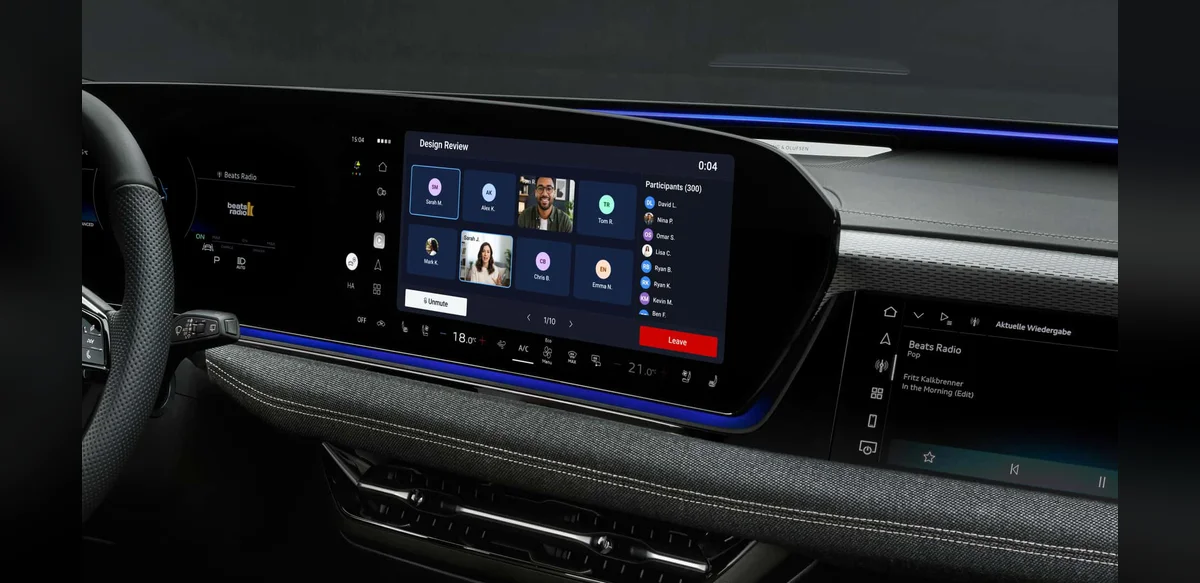
Audi has announced plans to incorporate a new voice assistant powered by Microsoft 365 into certain vehicle models scheduled for release in 2026. This feature will be available in 28 European markets and is designed to allow drivers to handle emails, manage calendars, and participate in Teams meetings without using their hands.
The integration aims to provide a seamless connection between the vehicle and common productivity tools. By using voice commands, users can access and respond to messages, check schedules, and join virtual meetings while keeping their attention on the road. The system is intended to operate in a hands-free manner to support safer driving practices.
This development reflects ongoing efforts in the automotive sector to blend everyday digital tools with in-car technology. The voice assistant will be offered on select models, indicating a targeted rollout rather than a universal addition across all vehicles. Availability is limited to the specified European regions for the initial launch.
Drivers will be able to issue spoken instructions to perform tasks that typically require manual interaction with a phone or computer. For instance, the assistant can read incoming emails aloud and allow dictation of replies. Calendar management includes checking appointments and adding new entries through voice alone. Participation in Teams meetings involves joining sessions and handling basic audio controls verbally.
The announcement highlights a focus on convenience for professionals who spend significant time in their vehicles. By embedding these capabilities directly into the car system, the need to switch between devices is reduced. This approach seeks to maintain connectivity while prioritizing road safety through minimized physical interactions.
Implementation details indicate that the feature will rely on existing Microsoft 365 services, ensuring compatibility with widely used business applications. The voice assistant is expected to function across various driving conditions within the supported markets. Audi has positioned this as an optional enhancement for users who rely on these tools regularly.
Overall, the move represents a step toward greater integration of office software within automotive environments. It builds on previous advancements in vehicle connectivity but centers specifically on productivity features from Microsoft. The limited scope to select models and European markets suggests a phased introduction that could expand later based on feedback and performance.
The technology is set to debut with the 2026 model year, giving the company time to refine the system before customer deliveries begin. Emphasis remains on hands-free operation to align with safety standards in the region. This addition could appeal to business users looking for ways to stay productive during commutes or longer trips without compromising attention to driving.
In summary, the voice assistant will enable core functions such as email handling, calendar oversight, and meeting participation through spoken commands. Its deployment in 28 European markets on chosen 2026 Audi models marks a notable update in how drivers interact with digital workspaces from behind the wheel.

