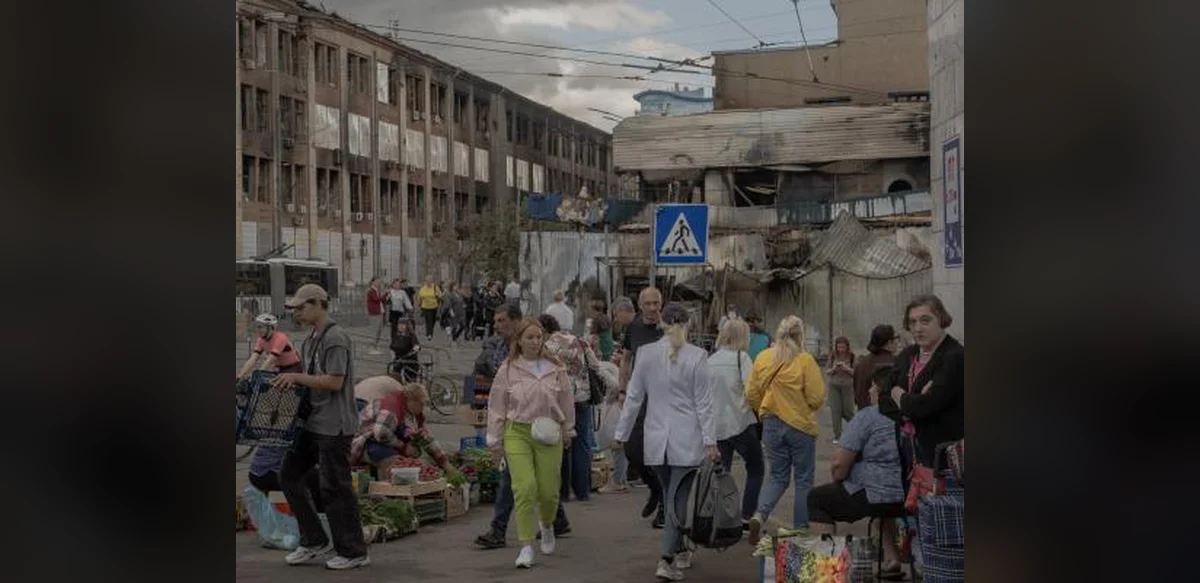
On Lukianivska Square in Kyiv’s most frequently targeted district, the white lettering on a busy McDonald’s has melted after a fire that spread from a nearby shopping centre hit during the major attack of 24 May. The restaurant remains open, yet an air-raid siren sends staff and customers down into the adjacent metro for shelter. The previous strike damaged part of the metro ceiling and left platforms covered in dust. The McDonald’s has suffered harm three times this year. Heat maps of air-raid activity across Kyiv show the area around Lukianivska Square and Shevchenkivskyi district with the highest concentration of strikes over four years. Residents report conditions have deteriorated further in recent months. In a large city where war damage is often absorbed, this neighbourhood resembles scenes nearer the front lines. Across the street from the metro stands the ruined red facade of the former Artem weapons plant, now partly hidden by a large mural. Recent strikes have also struck civilian sites. A glass tower nearby has lost many windows. Burnt cars remain at the kerb. The metro entrance, hit five times, is boarded up in places. Most activity now centres on a small market of flower and vegetable stalls beneath damaged structures. Anastasiia Prymak, 23, a product manager living in a nearby tower block, moved to Kyiv from Nikopol two years ago to escape constant shelling there. She describes recent heavy attacks, including a drone strike on an apartment building on 28 April. She has been diagnosed with severe anxiety disorder and experiences frequent panic attacks. A photograph on her phone shows flames shooting from a building visible from her window. After another strike last month she was taken to a shelter and later urged her boyfriend to relocate to Lviv. She describes the scene as resembling Chornobyl and sleeps in a curled position fearing a direct hit. In the wider air war, damage in this neighbourhood illustrates the conflict’s trajectory. Russian officials have indicated plans for heavier systematic strikes on Ukrainian cities. The rise in threats coincides with global shortages of interceptors, worsened by the US-Israeli conflict with Iran. President Zelenskyy has sought additional air-defence supplies during a recent visit to London. Flower-seller Faina Polishchuk notes that while traders have returned, customers have largely stayed away. She witnessed the May strike from her apartment and felt the building shake. She says she will remain unless the situation worsens, in which case she would return to Vinnytsia.