


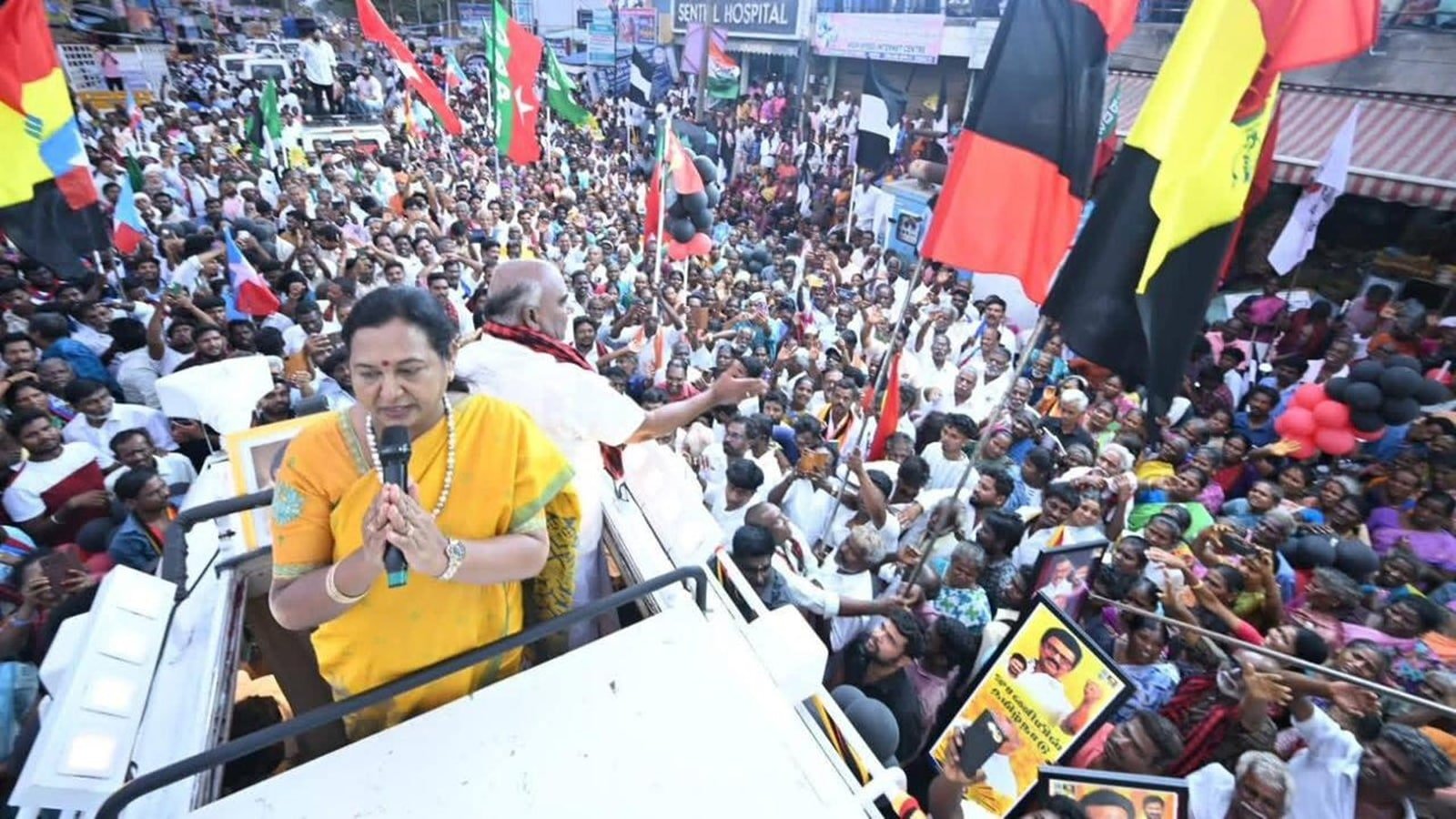
During election campaigns in rural parts of Tamil Nadu, Premalatha Vijayakanth rejected any similarities between her late husband, the actor and politician known as ‘Captain’ Vijayakanth, and Vijay, the new entrant leading the Tamilaga Vettri Kazhagam (TVK).
‘I hold no views on that,’ stated Premalatha, who heads the Desiya Murpokku Dravida Kazhagam (DMDK), established by her husband in 2005. She reiterated a common theme: Vijayakanth was more than an actor entering politics; he was a figure who connected deeply with ordinary citizens.
In the intense midday sun of Mangalampettai town near Virudhachalam—the area where Vijayakanth achieved his single yet significant win in 2006—the unspoken difference was evident: Vijay does not match the Captain’s stature.
Her convoy of SUVs navigated tight roads leading to small intersections and remote sections of Cuddalore district. Premalatha emerged into the blazing heat, maintaining a composed tone as she addressed various small groups.
Traces of Vijayakanth’s influence persisted in subtle forms around her. Local organizers, hurrying to set up seating or manage attendees, mirrored his style with neatly styled hair and ash marks on their foreheads. Over the years, the party seemed to have adopted the founder’s appearance.
For Premalatha, this likeness is more about political legacy than outward looks—a responsibility she now shoulders largely alone. ‘Captain was a champion for the public,’ she explained. ‘To help the community, he converted his fan groups into a political entity and participated in polls.’
This narrative fits into Tamil Nadu’s tradition of film stars entering politics, but Vijayakanth’s approach had its distinct elements. In the 2006 Assembly elections, the DMDK’s first, it competed in all 234 constituencies, securing only one seat but earning 8.38% of votes—a figure Premalatha often highlights.
‘We need to demonstrate that support level,’ she noted. ‘Even without immediate victories.’
The data reflects a pattern of growth followed by decline. Starting with 8.4% in 2006 and rising to 10.3% in the 2009 national elections, it dropped to 7.9% in 2011, though the party gained 29 seats—its peak and final Assembly wins. It further decreased to 5.1% in 2014, 2.4% in 2016, and 0.43% in 2021, reaching negligible levels.
Recollections of stronger periods
Yet Premalatha focuses on the initial vote shares as symbols of genuine public ties, not the downturn.
‘He was always the first to respond to any crisis,’ she recalled, citing events like floods, the 2004 tsunami, actions against sandalwood smuggling, and a village blast. ‘He would roll up his attire and join the affected directly,’ she added. This hands-on approach, she believes, is absent in many successors. ‘When the leader and the populace differ, true connection fails to form.’
Her words serve as guidance and subtle criticism—not only of Vijay but of newer leaders influenced by modern media. Premalatha occupies a transitional role: not a charismatic figurehead or conventional politician, but someone who entered the field through association, oversight, and eventual need. Her shift—from being seen as Vijayakanth’s coordinator to the DMDK’s main spokesperson—has been steady, though not without internal tensions.
In 2019, she bargained with competing coalitions headed by the DMK and AIADMK for the best seat allocations. ‘Politics has no lasting foes in parliamentary settings,’ she remarked, which contrasted with the party’s original outsider stance.
Prior to finalizing the DMDK’s agreement with the DMK in February, sources within the party indicated Premalatha contacted the AIADMK, BJP, and even Vijay’s TVK. This marks the DMDK’s initial alliance with the DMK, valued by strategists more for Vijayakanth’s enduring supporters—a loyal group that persists in rallies due to nostalgia, allegiance, and cultural bonds, despite ongoing losses.
Now, Premalatha presents her position as one of preservation rather than deal-making. ‘Achieving Vijayakanth’s visions and objectives is the DMDK’s sole aim,’ she affirmed.
This perspective also applies to gender issues. When questioned about operating in a field led by men such as M K Stalin and Edappadi K Palaniswami, she rejected the idea.
‘Politics has no bias based on gender,’ she asserted. ‘Everyone is a citizen with duties.’ She cites Indira Gandhi and J Jayalalithaa as inspirations—women who commanded their arenas. ‘I don’t view things through a lens of gender. I focus on what is correct.’

