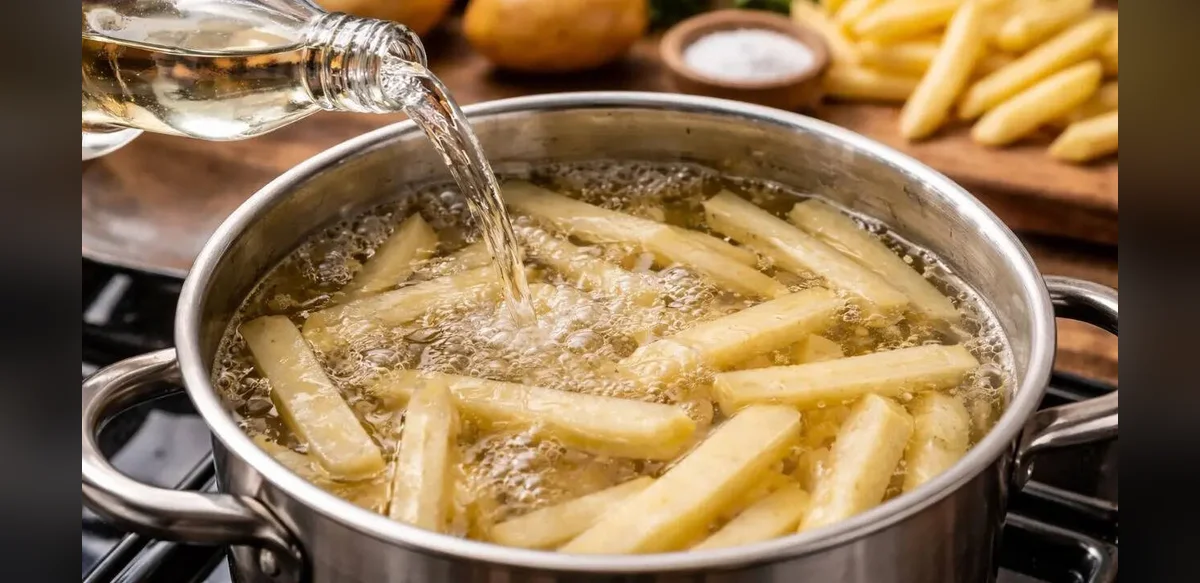
Achieving restaurant-quality crispy french fries at home can be challenging, often resulting in soggy or uneven textures despite using the right oils and temperatures. A straightforward kitchen technique, commonly used by professionals, leverages food science to produce fries that are crunchy on the outside and soft inside. This method is increasingly popular among home cooks seeking better results.
The key lies in vinegar’s acidity, which interacts with the potato’s surface when slices are soaked or briefly boiled in a vinegar-water solution. This strengthens the outer layers, preventing them from breaking down during cooking and allowing a crisp crust to form evenly.
Soaking draws excess starch to the surface, which crisps up during frying to create a golden exterior. Vinegar also reduces moisture content, avoiding sogginess and promoting better crisping.
Scientifically, potatoes contain pectin that holds their cell structure together. Boiling without additives can weaken this, leading to soft results. Adding vinegar lowers the water’s pH, slowing pectin breakdown and keeping potatoes firm for the initial boil, setting up ideal frying conditions.
Concerns about flavor alteration are minimal, as only a small amount of vinegar is used, and potatoes are rinsed and dried afterward, preserving their natural taste while improving texture.
To apply this, cut potatoes into even strips, rinse off starch, then soak or boil briefly in vinegar-water. Drain and dry thoroughly before frying.
This affordable, simple approach requires no special equipment and significantly enhances outcomes, making it appealing for those replicating professional dishes at home.