


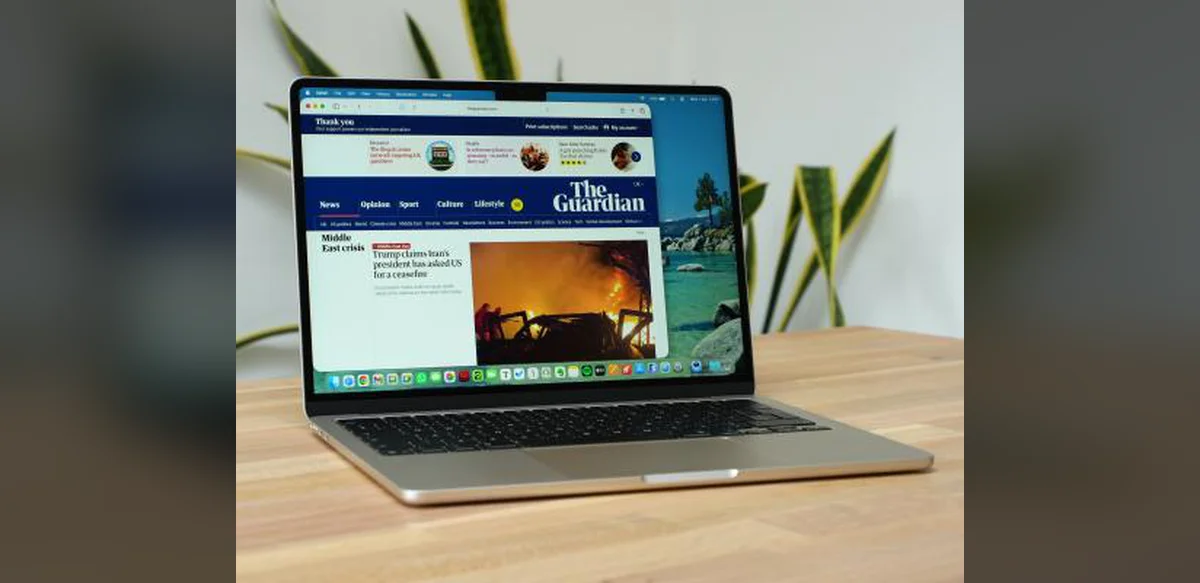
Apple’s newest MacBook Air model stands out as the company’s most capable version to date, featuring doubled base storage and exceptional suitability for productivity tasks, establishing it as a reference point for everyday laptops. However, the introduction of the more affordable MacBook Neo this year complicates the lineup.
The 13-inch M5 MacBook Air begins at £1,099 (€1,199/$1,099/A$1,799), a £100 increase over the prior M4 model, but it includes a minimum of 512GB storage. Positioned between the £599 MacBook Neo and the £1,699 M5 MacBook Pro, it serves as Apple’s mid-tier option.
Externally, the design remains unchanged from recent iterations. It continues to be Apple’s slimmest notebook, crafted from recycled aluminum with smooth edges and easy lid lifting. The 13.6-inch display retains its brightness, sharpness, and vibrancy, though it sticks to a standard 60Hz refresh rate, unlike the 120Hz screens on higher-end devices such as the MacBook Pro, iPad Pro, and latest iPhone models.
Specifications include: 13.6-inch LCD screen (2560×1664 resolution, 224 ppi) with True Tone; Apple M5 processor with 8- or 10-core GPU; 16GB, 24GB, or 32GB RAM; 512GB, 1TB, 2TB, or 4TB SSD; macOS 26 Tahoe; 12MP Center Stage camera; Wi-Fi 7, Bluetooth 6, two Thunderbolt/USB 4 ports, headphone jack; dimensions of 215 x 304.1 x 11.3mm; and weight of 1.23kg.
Internally, the M5 processor represents a significant advancement for Apple’s notebooks. It provides 10-20% better speed than the M4 in the previous model, a notable improvement. Compared to the M1 MacBook Air, it delivers 75-108% faster performance across various activities. It also surpasses the 2021 M1 Pro MacBook Pro in every measure, offering professional-grade capabilities in a compact form.
The inclusion of the N1 chip enhances connectivity with Bluetooth 6 and Wi-Fi 7, ensuring quicker and more stable wireless performance with compatible equipment. The upgraded SSD, starting at 512GB, is twice as fast as before, aiding demanding operations and accelerating data handling.
The M5 maintains the Air’s key advantage of extended battery duration. It typically endures over 17 hours for routine office activities like web browsing, note-taking, document creation, messaging, and email, plus several hours of image editing in tools such as Affinity and Pixelmator Pro. For intensive work like video processing, it lasts around 10 hours, allowing a full day of use without recharging—a feat many competing PCs struggle to match consistently.
On sustainability, the MacBook Air incorporates 55% recycled materials. Apple details its environmental footprint in a dedicated report. The battery is designed for over 1,000 full cycles while retaining at least 80% capacity, with replacements available from £179. The company provides trade-in programs and free recycling for various devices, including those from other brands.
Pricing starts at £1,099 (€1,199/$1,099/A$1,799) for the 13-inch model with an 8-core GPU, 16GB RAM, and 512GB storage. The 15-inch variant begins at £1,199 (€1,499/$1,299/A$2,199). In comparison, the A18 Pro MacBook Neo starts at £599, the M5 MacBook Pro at £1,699, the Samsung Galaxy Book 6 Pro at £1,619, and the 13.8-inch Microsoft Surface Laptop at £1,419.
In summary, the M5 MacBook Air upholds its status as the benchmark for slim, lightweight, and potent consumer laptops. It excels in construction, display, input devices, audio, camera, processing power, and battery endurance. Competitors might offer superior displays, stronger graphics, or more ports—the Air has just two USB-C connections. Yet, no other combines these elements as effectively, unless specific software needs dictate otherwise.
The MacBook Neo presents a budget-friendly alternative at about half the cost, ideal for basic tasks. Nevertheless, the M5 MacBook Air remains the superior choice for a high-end, versatile laptop suited for long-term professional or recreational use.
Advantages: Swift M5 processor and outstanding battery life, fanless and quiet operation, solid 13.6-inch display, excellent keyboard, top-tier trackpad, MagSafe charging, quality speakers, Center Stage camera, Touch ID, Wi-Fi 7 and Bluetooth 6 support, minimum 512GB storage.
Drawbacks: Limited to two USB-C ports, lacks USB-A or SD slots, no Face ID, costly upgrades for RAM and storage that are fixed post-purchase, no included power adapter in the UK.

