


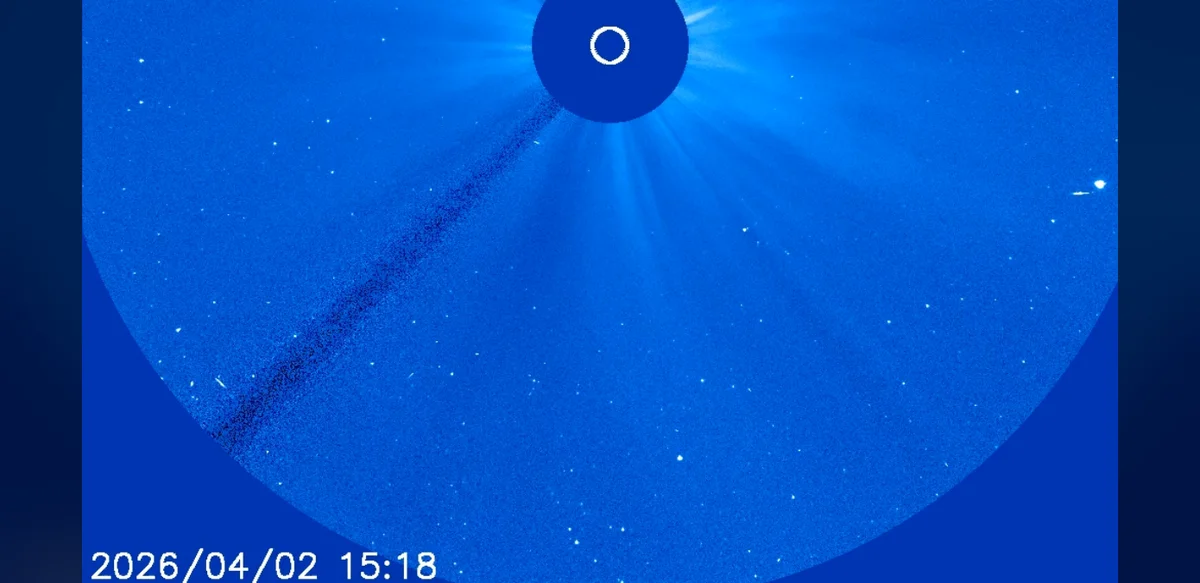
In April 2026, the sungrazer comet C/2026 A1, also known as MAPS, ventured near the Sun on a sharp path. Belonging to the Kreutz group, this comet was initially spotted by amateur astronomers months prior to its destruction. NASA instruments recorded its perihelion passage, revealing that it failed to endure the solar encounter. Insights from the comet’s vaporization in the Sun’s atmosphere enhance knowledge of its composition and the origins of the solar system.
Solar Probes Monitor Comet MAPS
A NASA statement indicates that various agency spacecraft tracked Comet MAPS. The SOHO mission’s LASCO instrument detected the comet intact as it neared the Sun, but only a debris plume appeared afterward. From another viewpoint, the STEREO spacecraft observed the comet orbiting the Sun before it disappeared. The lead researcher for SOHO’s instrument stated that MAPS ‘was evidently obliterated — probably a few hours prior to its nearest point to the Sun.’ NASA’s recent PUNCH project photographed MAPS on April 1 before its approach and will monitor its tail affected by solar wind. In a similar vein, the Parker Solar Probe’s WISPR tool imaged a different sungrazing comet in 2020, demonstrating how extreme solar radiation leads to their fragmentation.
Reasons for Comets Fragmenting Near the Sun
As a comet draws close to the Sun, its icy core heats up, generating internal pressure that fractures the nucleus. Additional factors include the Sun’s gravitational pull and the comet’s rapid speed of around 1.6 million kilometers per hour. Ultimately, only vapor and particles persist. Examining these disintegrations holds value for multiple scientific purposes.

