


The West Bengal assembly elections highlight three key narratives. First, voters have faced significant obstacles in exercising their right to vote, with apparent efforts to selectively disenfranchise certain groups, effectively allowing the system to pick the electorate rather than the reverse.
Second, amid calls for increased female participation in politics, a prominent female leader is battling on multiple fronts—legal, political, and verbal—as election rules and officials seem adjusted to undermine her position.
These issues tie into the Bharatiya Janata Party’s (BJP) intense drive to gain control of the state. West Bengal represents half of the initial religious partition of India by the British, and the Hindu-Muslim divide aligns with Hindutva ideology.
Additionally, the state is the origin of ‘Vande Mataram,’ which the BJP seeks to appropriate to bolster its historical narrative from the independence movement. It is also the birthplace of Syama Prasad Mookerjee, founder of the Bharatiya Jan Sangh, the BJP’s predecessor.
Mamata Banerjee’s Campaign Approach
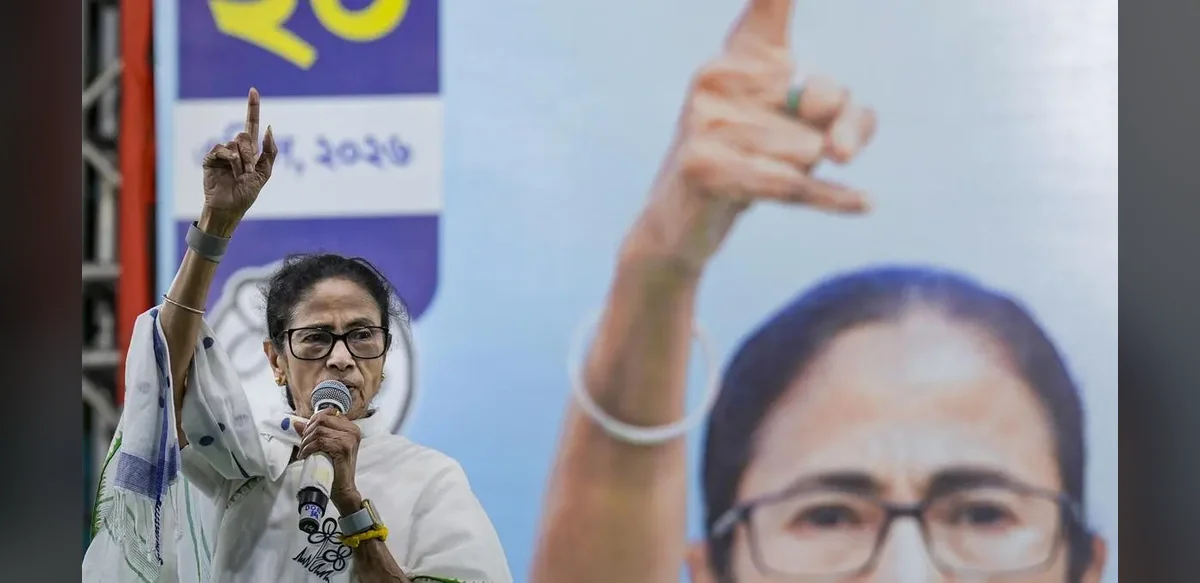
On a humid afternoon at Dum Dum Central Jail grounds in Kolkata, Chief Minister Mamata Banerjee, dressed in her signature white sari, addressed the crowd energetically. Speaking primarily in Bengali with some Hindi and English phrases, she highlighted alleged constitutional violations, targeting of her Trinamool Congress party by central agencies, voter list deletions, deployment of central security forces, and efforts by BJP figures to oppose her.
Her strategy emphasizes a local Bengali identity against external intruders, referencing notable figures from Bengal’s history. Despite holding power for three terms and aiming for a fourth, she campaigns with the vigor of an opposition candidate.
Banerjee is an effective orator who maintains momentum throughout. She also underscores gender representation: Trinamool has 29 members of parliament, with 38% women—the highest rate among parties—compared to 13% for the BJP. In the assembly elections, Trinamool nominated 52 women (18% of candidates) out of 291 seats, while the BJP fielded 33 (11%).
Kolkata is filled with central security personnel extending into rural areas. While reporting on a BJP candidate’s campaign in south Kolkata—a former journalist—the following day revealed an ongoing income tax raid at the incumbent Trinamool legislator’s location.
Attempts to contact I-PAC, the firm managing Trinamool’s campaign, were hindered as enforcement directorate raids forced them into hiding. I-PAC previously supported Trinamool in the 2021 assembly and 2024 national elections. Rumors suggested I-PAC had ceased operations in the state, which Trinamool denied, indicating intense pressure from authorities.
With reduced voter rolls, administrative changes, and efforts to weaken Trinamool’s structure, conditions appear tilted in the BJP’s favor.
BJP’s Strategy
Elections involve both numerical calculations and voter sentiment. The BJP has worked to alter demographics, targeting the state’s sizable Muslim community and female voters. In Kolkata’s Park Circus, disenfranchised individuals protested under the watch of central forces.
For sentiment, Prime Minister Narendra Modi leads vigorous campaigning without personal criticisms of Banerjee. He connects locally by sharing images of enjoying jhalmuri, a puffed rice snack, though mispronouncing it as jhal-muli. Food features prominently, with BJP candidates displaying fish to soften the party’s vegetarian reputation.
The core message focuses on infiltrators. A BJP victory could import tactics from Assam, intensifying claims that Bengali Muslims originate from Bangladesh. However, in Bengal, Hindus and Muslims largely share the Bengali language.
Communal tensions exist subtly in the state, where some residents hold unspoken biases but reject overt divisions. The educated elite view themselves as above such conflicts.
Trinamool Versus BJP
Urban areas show some dissatisfaction with Trinamool, but rural regions report less anti-incumbency. Trinamool retains strong support among women voters.

