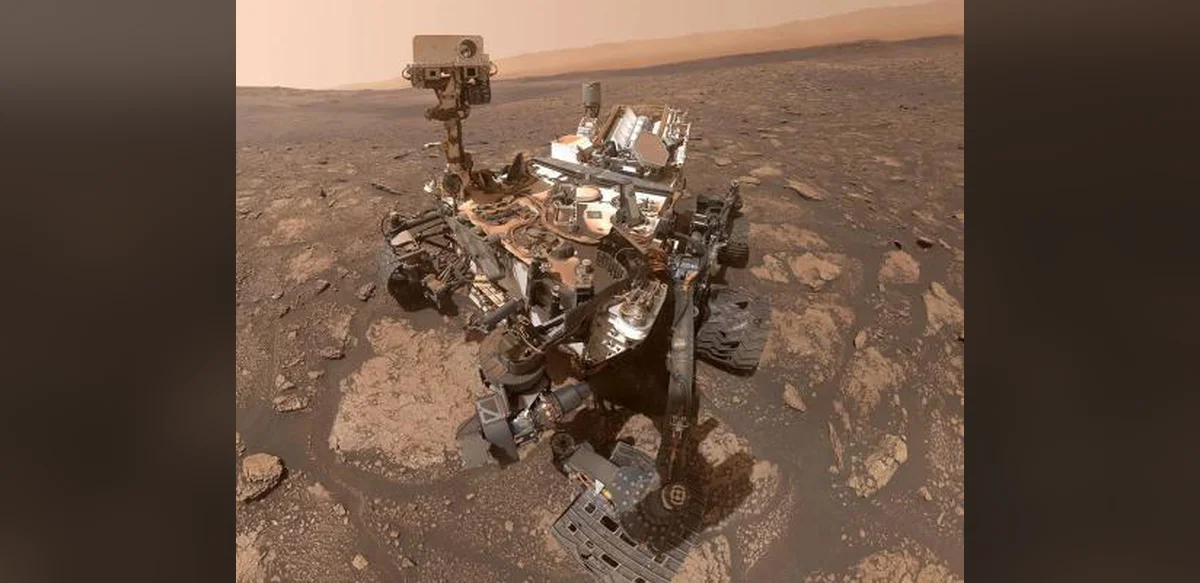
NASA’s Curiosity rover has identified organic molecules on Mars, some of which are seen as essential components for the emergence of life on Earth. Among the seven molecules found in a former lakebed near the planet’s equator, five were previously undetected there. The rover’s examination cannot determine if these compounds stem from ancient biological activity, meteorite impacts, or geological formations. Still, the discovery suggests that remnants of any past microbial life on Mars could endure today. ‘We believe this organic material has been preserved on Mars for about 3.5 billion years,’ stated Prof Amy Williams, an astrogeologist at the University of Florida and a scientist on the Curiosity team, who oversaw the study. ‘Does this indicate life? We cannot confirm that from these results.’ The vehicle-sized rover has been exploring Gale crater and Mount Sharp since landing in 2012. Mars’ surface is extreme, with nighttime temperatures falling below -100C and intense solar radiation due to the thin atmosphere. However, billions of years ago, the planet had flowing water and a protective atmosphere. ‘It possessed all the necessary elements for life to begin, similar to Earth at that time,’ noted Prof Andrew Coates, a planetary scientist at University College London’s Mullard Space Science Laboratory, who was not part of this research. ‘There is no apparent reason why life could not have originated on Mars too.’ Researchers have questioned whether chemical signs of life from Mars’ habitable period, roughly 3.7 to 4.1 billion years ago, would persist. Williams added: ‘We long assumed that harsh radiation would break down all organic substances. It is thrilling to discover that complex materials can endure underground.’ The rover employed its instruments to identify carbon-based compounds associated with life. It found benzothiophene, a sulfur-containing substance often brought by meteorites. The analysis also suggested a nitrogen-rich organic molecule resembling DNA building blocks. ‘Several stages separate our findings from actual DNA,’ Williams explained. ‘It is a fundamental component in DNA formation, but merely the raw materials, not the complete structure. Such molecules can form through non-biological means.’ She continued: ‘Similar materials from meteorites reached both Mars and Earth, likely supplying the foundations for life on our world.’ These results boost expectations for the European Space Agency’s upcoming Rosalind Franklin mission, set for 2028 after delays. That rover will drill up to 2 meters deep and conduct advanced analyses to evaluate the sources of these compounds. The study appears in Nature Communications.