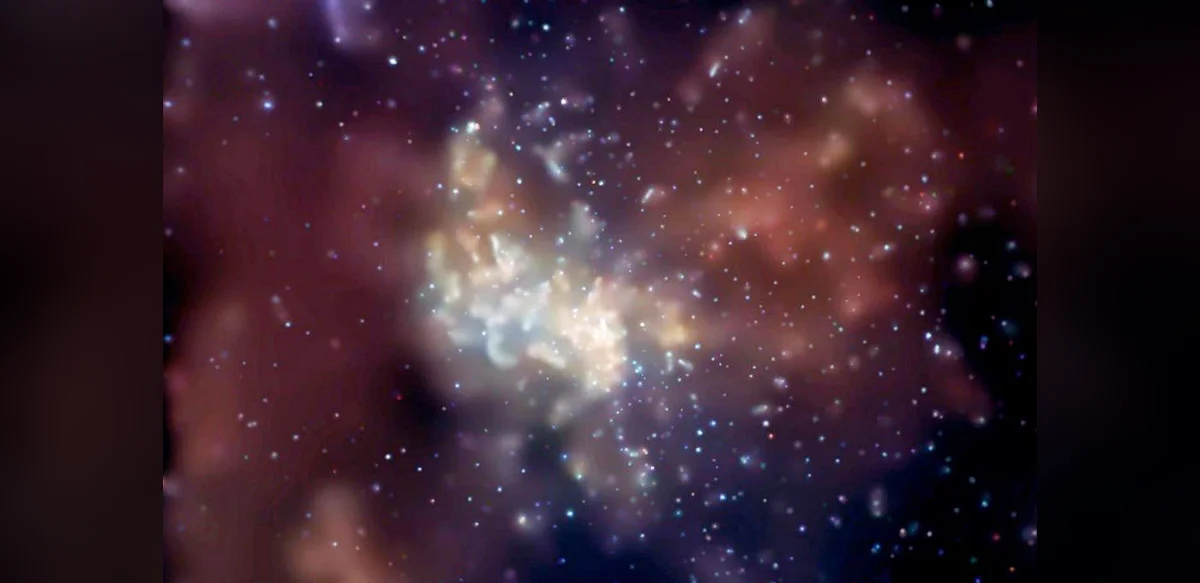
The region around the Milky Way’s central supermassive black hole hosts three distinct groups of stars that differ markedly yet share similar ages. A single undetected black hole may unify explanations for all three. Sagittarius A* is encircled by S-stars on elongated paths forming a spherical swarm with an unexplained gap known as the zone of avoidance. Beyond them lies a clockwise disc of massive stars in orderly orbits. Farther out are off-disc stars on scattered trajectories, some moving opposite to the others. Previous models addressed each group separately without consistency. Researchers built a simulation incorporating one additional intermediate-mass black hole several hundred to a thousand solar masses on a tilted orbit. This object perturbs the original shared disc through three gravitational effects: strong scattering of outer stars, resonant stretching of the middle disc, and minimal direct influence on inner stars whose chaos arises from mutual interactions. The model reproduces all observed features without invoking multiple unrelated formation events. A candidate cluster, IRS-13E, may contain such an object, though confirmation requires further observations.