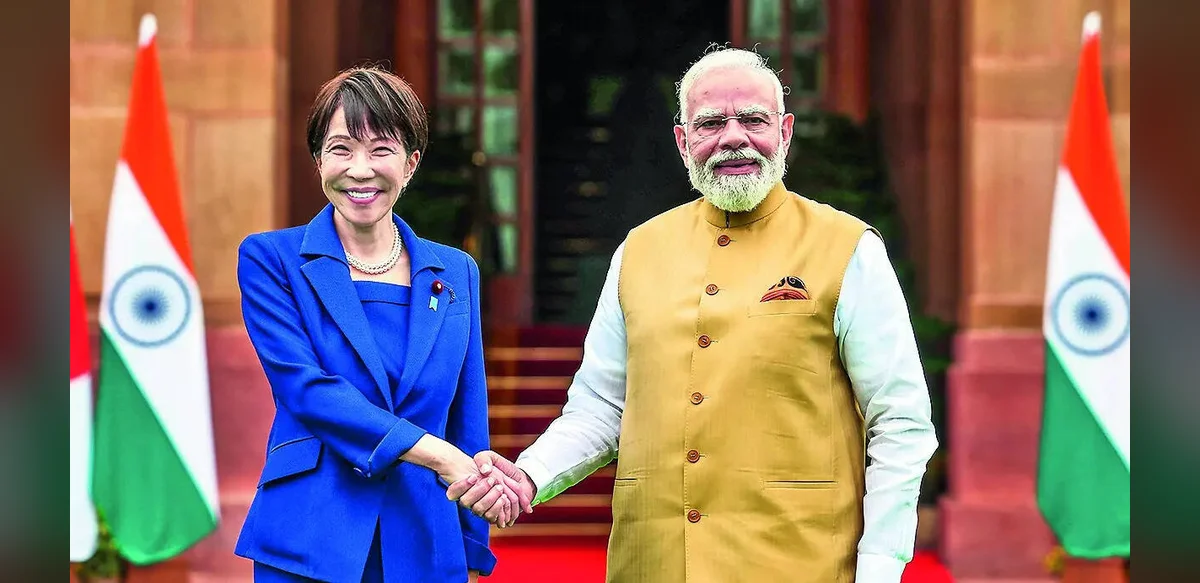
India and Japan have broadened their partnership in artificial intelligence, committing to build a safe, secure, trustworthy, inclusive, human-centered, sustainable, accountable and innovation-focused AI system covering the full technology range. During a briefing on the Japanese prime minister’s visit to India, the foreign secretary noted that AI has become a key growth area in bilateral ties, with both nations aligning on governance, innovation, infrastructure and applications. Leaders issued a joint statement recognizing AI as a transformative general-purpose technology affecting economies, societies, science, governance, industry and security. They agreed that decisions on AI design, development, deployment and oversight will shape long-term innovation, welfare, economic security and global order. Both countries will work to boost resilience, competitiveness and growth while advancing the shared AI ecosystem goals. Cooperation will align with India’s MAHASAGAR vision and Japan’s Free and Open Indo-Pacific framework, extending to like-minded partners in the Indo-Pacific and Global South. On governance, they supported a global approach centered on safe, secure, trustworthy, robust and inclusive AI, with rules that are risk-balanced, participatory, informed, proportionate, interoperable and adaptive. They backed the Hiroshima AI Process and coordination in forums such as the G20, OECD, GPAI and the United Nations. The nations will deepen collaboration throughout the AI lifecycle, covering model evaluation, capability assessment, benchmarks and safety tools. They highlighted risks of frontier systems and described cyberspace as a global public good, calling for risk-based evaluation and trusted access. Infrastructure cooperation will cover secure digital systems, data centers, GPU capacity, semiconductors and AI computing resources, with assessments of vulnerabilities from an economic-security viewpoint. They welcomed progress under the FOIP Digital Corridor Initiative. In research and model development, they will promote multilingual, open-source and domain-specific models. Key agreements include work between IIT Bombay’s BharatGen and Japan’s National Institute of Informatics on multilingual scientific language models, and between Sarvam AI and Preferred Networks on full-stack development. They also encouraged AI-enabled scientific discovery through the Network of AI for Science Institutions. Human resources efforts will expand industry-academia ties and talent exchanges in AI and semiconductors. Japan acknowledged India’s strong AI workforce and supported greater engagement by Japanese firms with Indian institutions. The target remains to bring 500 skilled AI professionals from India to Japan by 2030, alongside joint research, internships and jobs. Leaders called for co-creation of AI solutions for public benefit, urging governments, startups, academia and industry to build scalable applications and use the Global AI Impact Commons. Under the AI for All vision, they reaffirmed that AI should benefit all humanity and support inclusive, sustainable development while enhancing public services. Japan announced plans to host an AI summit soon, further strengthening bilateral technology ties.