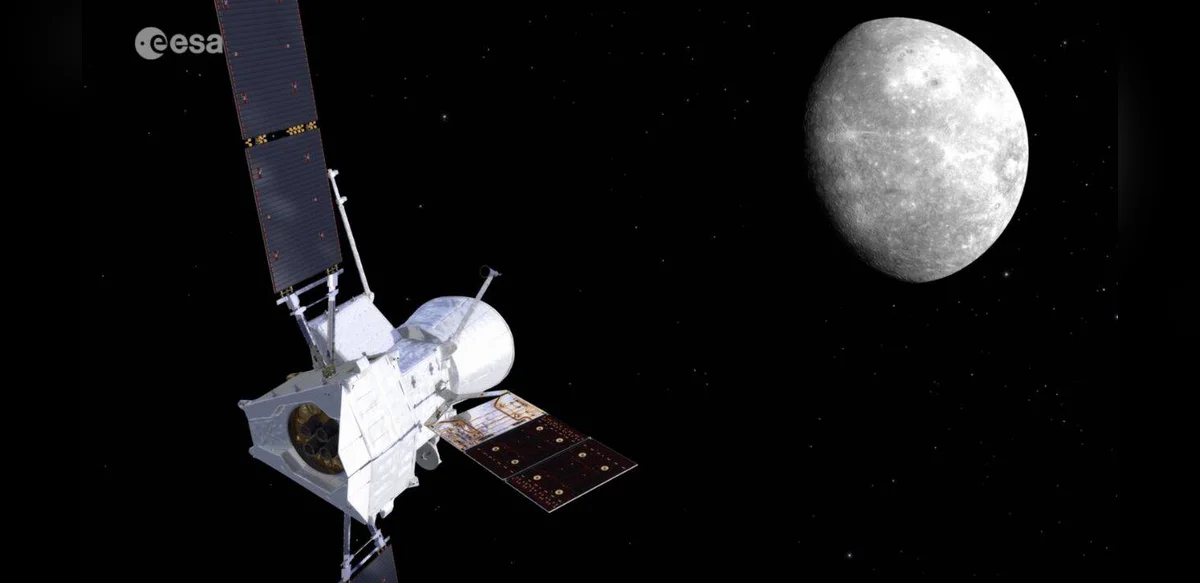
For most space missions the launch draws headlines, yet BepiColombo reaches its key milestone years afterward. After nearly eight years traveling through the inner Solar System the European-Japanese probe is closing in on its intended destination. According to ESA the craft should enter Mercury orbit in November 2026, completing one of the longest and most precisely controlled planetary voyages attempted. The extended timeline was planned rather than accidental. Reaching the planet closest to the Sun requires repeated gravity assists and steady corrections instead of a straight path. Once in orbit the mission will open a fresh phase of study on a world that has stayed largely unknown despite its nearness to Earth. Mercury has received far fewer visits than Mars or Venus. Its proximity to the Sun creates severe technical challenges, resulting in only a few encounters over five decades. NASA’s Mariner 10 provided the first close images in the 1970s but performed only flybys. Later NASA’s MESSENGER orbited the planet from 2011 to 2015 and greatly improved knowledge of its surface, magnetic field and makeup. BepiColombo will become the third mission to reach Mercury and the second to orbit it. Although Mercury appears nearer than Mars on diagrams, distance alone does not explain the difficulty. A craft moving inward gains high speed from solar gravity. BepiColombo therefore spent years slowing down through a series of flybys at Earth, Venus and Mercury itself, supported by gentle ion propulsion. The approach relied on patience rather than speed. The spacecraft consists of three linked modules. The transfer module supplied propulsion during cruise while two separate orbiters ride above it. Europe’s Mercury Planetary Orbiter will examine the surface and interior, while Japan’s Mio will study the magnetic environment and solar wind interaction. Simultaneous observations will allow measurements of the planet and its surroundings together. An issue with electric propulsion performance emerged in 2024, traced to electrical currents in the solar array system. Reduced thrust forced a revised trajectory that uses additional Mercury gravity assists. The change preserved all scientific objectives but shifted orbit insertion from late 2025 to November 2026. The main cruise phase with ion engines ended in 2026. Arrival will occur gradually through continued small adjustments rather than one large braking burn.