


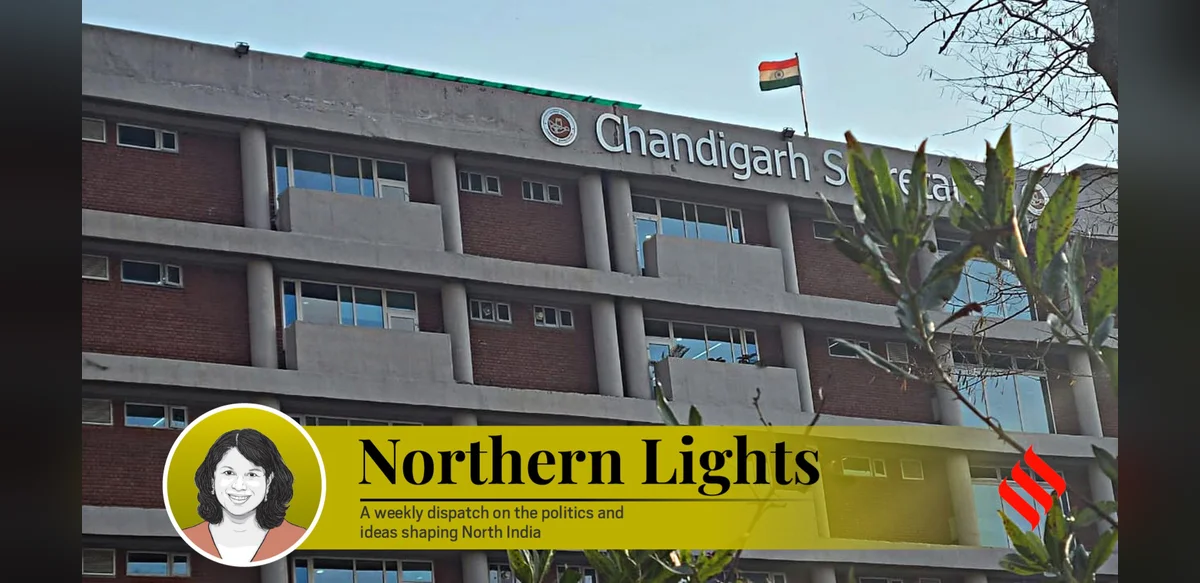
Last week Himachal Pradesh Chief Minister Sukhvinder Singh Sukhu visited Chandigarh to meet Punjab Governor and Chandigarh Administrator Gulab Chand Kataria. He requested a 7.19 per cent share in the Union Territory, claiming Himachal deserved it as a successor state after its separation from Punjab in 1966.
Earlier this year Punjab Chief Minister Bhagwant Mann highlighted Chandigarh in his Republic Day speech, stressing that Punjab would secure full control of the city.
The issue has surfaced repeatedly. Four years ago, after Union Home Minister Amit Shah said central civil service rules would apply to Chandigarh Administration staff instead of Punjab rules, the AAP government held a special assembly session and passed a resolution demanding immediate transfer of the city.
Haryana Chief Minister Nayab Singh Saini continues to describe Chandigarh as the joint capital while seeking land for a separate state assembly building.
Six decades after becoming the joint capital of Punjab and Haryana, Chandigarh remains disputed. Yet the city has grown beyond a simple territorial claim.
Created after Partition to replace Lahore as Punjab’s capital, Chandigarh became India’s first planned city, designed by Swiss-French architect Le Corbusier. Its Capitol Complex, which includes the Assembly, Secretariat and High Court, now holds UNESCO World Heritage status.
Its political status stayed unresolved. When Punjab was reorganised along linguistic lines in 1966, creating Punjab, Haryana and the areas that became Himachal Pradesh, Chandigarh was made a Union Territory and temporary joint capital.
In 1970 Prime Minister Indira Gandhi announced Chandigarh would go to Punjab while Haryana would receive Fazilka tehsil or similar land plus funds for a new capital. The plan stalled.
Fifteen years later the Rajiv-Longowal Accord set 26 January 1986 as the transfer date to Punjab after exchange of Hindi-speaking areas. Militancy halted the process and the accord was never implemented.
Successive governments have raised the matter when politically useful. The city itself has moved forward.
It now anchors the Tricity area between Mohali in Punjab and Panchkula in Haryana. Residents often live in one place, work in another and socialise across all three.
Politically the region shows India’s variety: AAP governs Mohali, Chandigarh has a Congress MP yet a BJP-led municipal corporation, and Panchkula is represented by the BJP. Local elections frequently signal trends in Punjab.
Chandigarh developed a distinct social makeup. Built across 22 Punjab villages and mango orchards, it attracted refugees, officials, lawyers, professionals and entrepreneurs from across India.
Its character was shaped by first Chief Commissioner M S Randhawa, known as Punjab’s sixth river. He created the Rose Garden, founded the Government Museum and Art Gallery, and oversaw planting of amaltas, gulmohar and jacaranda trees that still define the sectors.

