


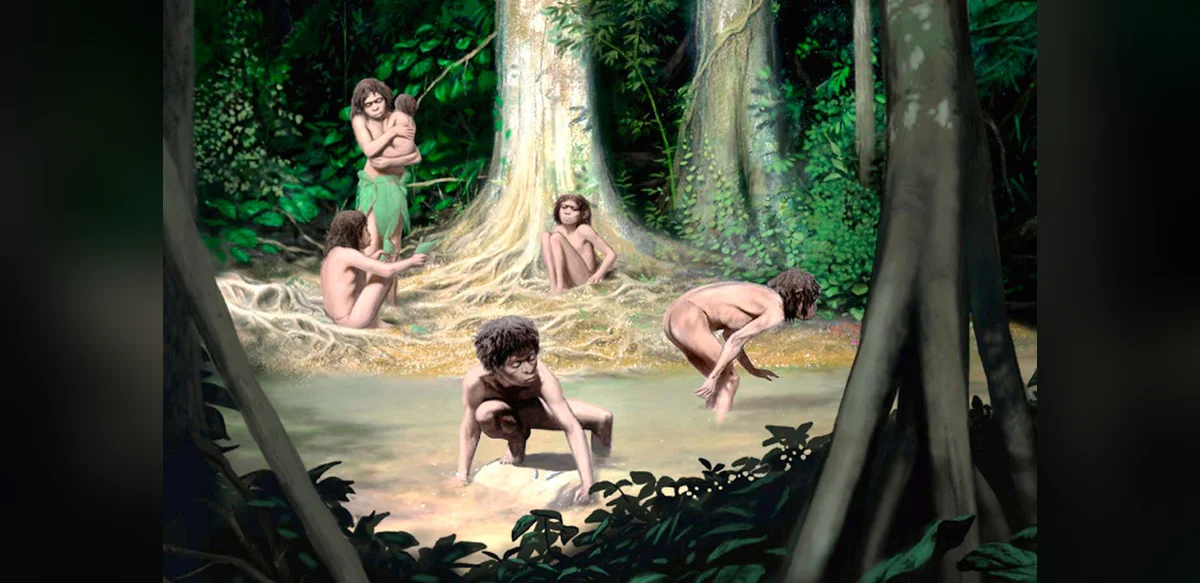
An experiment feeding a dead goat to a Komodo dragon along with analysis of thousands of ancient bones indicates that Homo floresiensis neither hunted large game skillfully nor mastered fire use.
Homo floresiensis was a small hominin species that lived on the island of Flores.
The tiny ancient humans known as hobbits inhabited the Indonesian island of Flores until about 50,000 years ago and showed limited hunting abilities, based on a study of animal bones from their caves. Researchers conclude they instead scavenged meat discarded by Komodo dragons.
Fossils of Homo floresiensis were first reported in 2004. These humans measured just over a metre in height, with remains dated between 90,000 and 50,000 years old.
Stone tools and blackened bones found with their fossils initially suggested advanced skills including controlled fire use and hunting of the island’s largest animals. Recent debate has questioned the cognitive abilities of these small-brained hominins.
Elizabeth Veatch at the Smithsonian Institution notes that many researchers still assume Homo floresiensis required advanced cognition to reach and survive on the island despite its small brain size.
The Liang Bua cave holding H. floresiensis remains includes numerous bones from a dwarf elephant species. Veatch and colleagues proposed these animals were killed by Komodo dragons, large reptiles still present on Flores.
To identify tooth marks left by Komodo dragons on large mammal bones, the team fed a dead goat to one such reptile at Zoo Atlanta. They noted that experimenting with an extinct Stegodon would have been impractical.
After the Komodo finished eating, 72 bones remained with 192 tooth marks on 26 of them. Researchers compared these to over 3,000 Stegodon fragments from layers linked only to H. floresiensis and nearly 7,000 later rat bones associated with Homo sapiens. They also checked roughly 10,000 bones for fire exposure.
The goat experiment showed Komodo dragons preferred meat-rich sections such as hindquarters and forequarters.
Cut marks from H. floresiensis stone tools appeared mainly on less desirable Stegodon parts like cranial bones and thoracic vertebrae, suggesting humans did not have first access to the carcasses.
Only one of more than 3,000 Stegodon bones linked to the small hominins showed possible fire exposure, likely from later disturbance. In contrast, one fifth of rat bones from modern human layers displayed cooking signs.
Veatch states the rat bones show a clear pattern of no burned remains in Homo floresiensis layers versus hundreds in modern human layers, confirming the species did not use fire or hunt big game.
Adam Brumm at Griffith University finds the evidence convincing that Homo floresiensis scavenged rather than hunted Stegodon.
Martin Porr at the University of Western Australia notes prior claims of hunting and fire use were already disputed, and the new results align Homo floresiensis with other small-bodied hominins given its brain and body size.
The origin of Homo floresiensis remains unclear, whether from smaller widespread hominins or from larger ones like Homo erectus that reduced in size.
Porr concludes both possibilities stay open and require further research on and near Flores.

