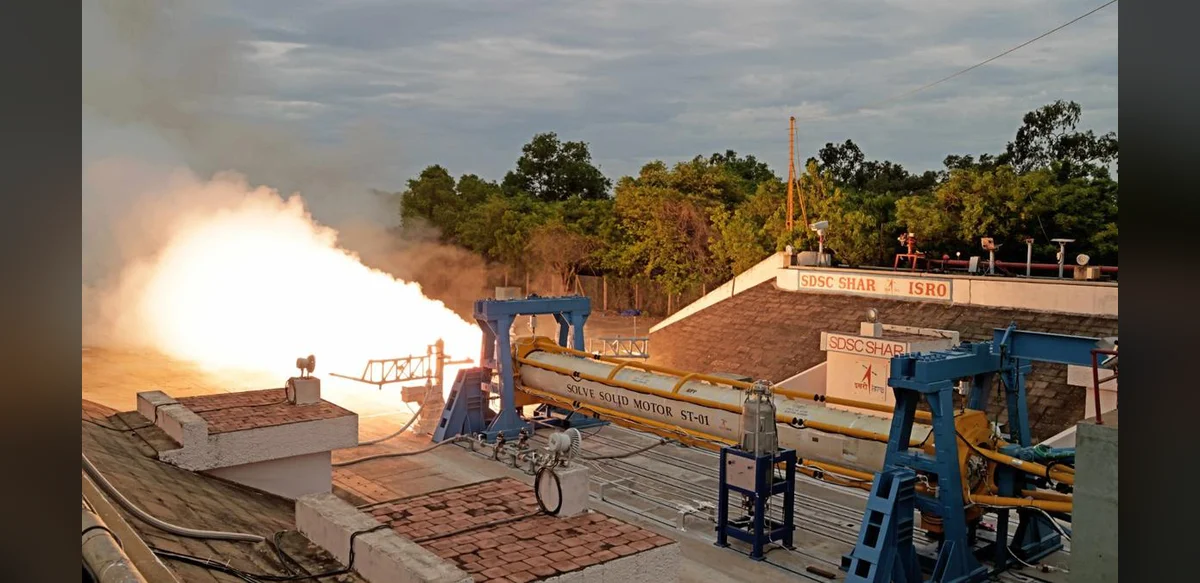
The Indian Space Research Organisation has completed the first ground test of the Sub-Orbital Launch Vehicle for Experiments solid motor at the Static Test Facility in Sriharikota. The motor forms a central element in preparations for Gaganyaan test flights. Conducted on July 3, the trial supports integrated parachute validation for the crew module’s deceleration system under varied conditions. In upcoming flights the module will reach altitudes between 10 and 17 kilometres before separation. Ten parachutes will then slow its descent ahead of a sea landing. The motor design draws from the Polar Satellite Launch Vehicle strap-on stage, incorporating a slower-burning propellant and a straight nozzle with secondary injection thrust vector control. Performance data met expectations. The SOLVE platform adds flexibility for simulating different mission scenarios. Recent related activities include the second integrated air-drop test and a behavioural study conducted in Leh with the selected crew and support teams. The first uncrewed Gaganyaan flight, originally planned for early 2026, has been postponed. The overall programme aims to place three astronauts in a 400-kilometre orbit for three days and return them safely to Indian waters.