


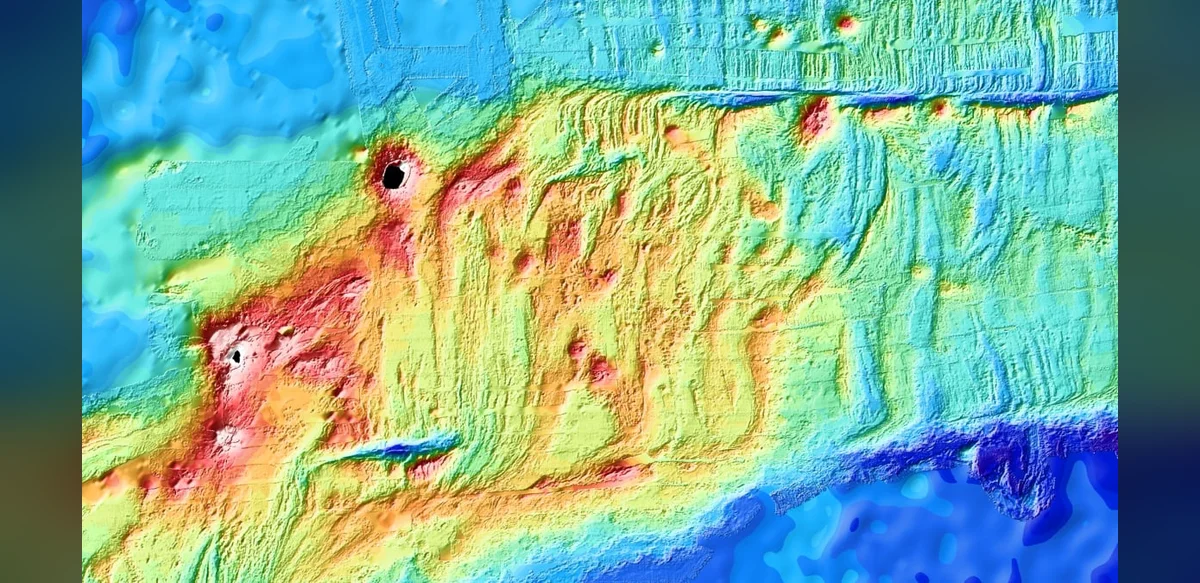
Most of Earth’s crust forms in underwater processes rarely observed directly. A network of mid-ocean ridges spanning 65,000 kilometers marks where tectonic plates diverge. In these remote depths, sudden movements open fissures that fill with magma, which cools to create fresh crust. Over two-thirds of the planet’s surface originated this way, and scientists have now documented one such episode in real time.
The team had not expected to witness a major occurrence and instead planned to track gradual ridge movement of a few centimeters. Instead, they recorded a rare event occurring once every forty years, with several meters of displacement in multiple directions. The findings appear in a recent Nature paper.
Tectonic boundaries lie deep underwater, making direct study difficult. In February 2024, researchers installed the OHA-GEODAMS observatory near Amsterdam Island along the Southeast Indian Ridge. The system used five hydrophones to monitor the Saint Paul-Amsterdam plateau for sudden spreading episodes.
Seafloor formation happens in abrupt bursts after decades of stress accumulation. In April 2024, the ridge axis fractured, allowing magma to move into the crust. Sheet-like intrusions known as dikes advanced in under two hours, emplacing roughly 150 million cubic meters of material. The intrusions caused earthquakes, reactivated old faults, and emptied part of the underlying magma chamber.
The seafloor above subsided quickly, dropping 4.2 meters along boundary faults. Lava eventually reached the surface while further drainage increased the collapse. This marked the first hourly observation of a spreading event that combined both dike intrusion and fault movement.
Typical spreading rates average 6.3 centimeters per year if steady. During the episode, separation reached five centimeters per minute at peak, nearly half a million times the long-term average. Horizontal shifts of two to four meters matched thirty to sixty years of normal motion.

