


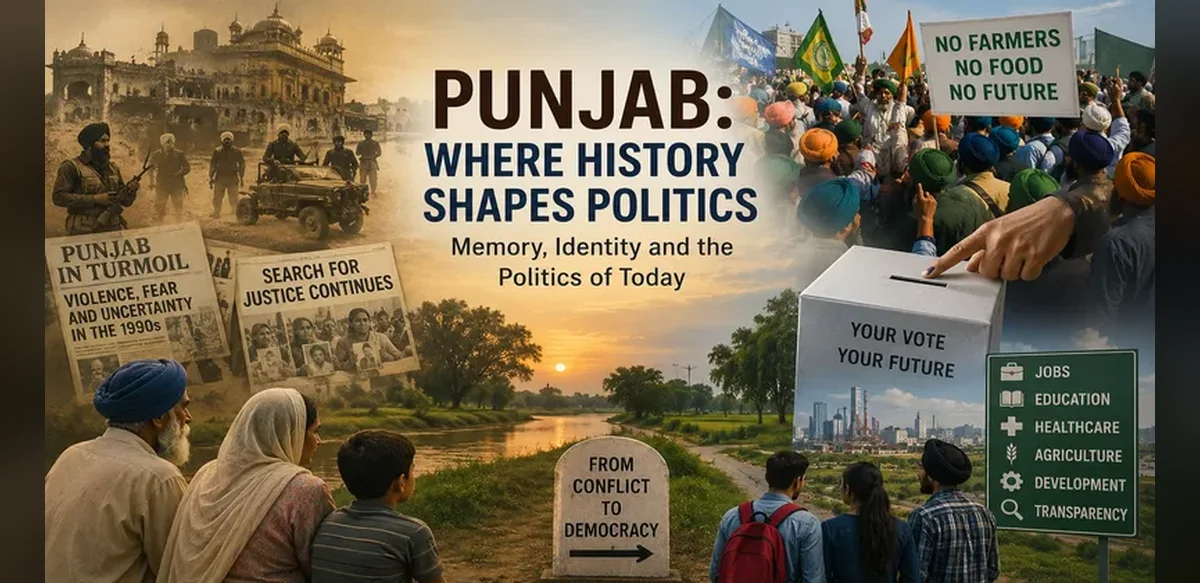
More than thirty years after the violence of the late 1980s and early 1990s, Punjab still grapples with that era’s impact on its politics, voting patterns, and public debate. The situation shows that the state’s history is not limited to books or records but actively molds political identities, campaign stories, and citizen expectations.
In contrast to many other Indian states where polls focus mainly on economic matters or leader rivalries, Punjab’s scene has long been defined by historical remembrance. This does not trap voters in bygone times. Instead, past events offer a lens for viewing present concerns. Issues of federalism, religious identity, security, farm policy, migration, and administration are frequently viewed through the state’s conflict and recovery years.
The origins of this memory reach further back. After independence, Punjab saw language-based state changes, the Green Revolution, calls for more autonomy, and shifting Centre-State ties. These factors linked regional identity tightly to governance. By the late 1970s and early 1980s, political disputes increasingly mixed with religious and constitutional matters, leading to one of the state’s toughest modern phases.
Militancy-related violence in the 1980s and early 1990s affected all areas of public life. Civilians, police, officials, journalists, religious leaders, and party workers suffered losses. Counterinsurgency operations also sparked lasting questions about accountability. Families endured varied hardships, preventing any single account of the period. Some recall it mainly as terrorism disrupting daily routines, while others note unresolved cases of disappearances and rights violations. Many hold both views at once.
The return of elections in the 1990s signaled a shift from conflict to democratic stability. Polls came to represent institutional healing as competition replaced armed clashes. Later governments worked to rebuild trust, fix administration, and boost the economy. Though security stayed important, talk turned gradually to growth, farming, roads, and services. Yet conflict memories stayed within institutions and society, affecting trust and voting habits.
The state’s party structure shows this continuity. Rivalry between regional and national groups often centers on differing views of Punjab’s place in India. Regional outfits stress federalism, language ties, farm issues, and Sikh bodies, while national ones focus on unity, security, and broader economics. In reality, these lines blur as parties adjust to electoral needs.
Farming illustrates the pattern too. The Green Revolution made Punjab highly productive but brought problems like falling water tables, crop shifts, and income pressures. Protest movements often invoke stories of past sacrifice and regional contribution. During the 2020-2021 farm law demonstrations, historical references mixed with economic demands, showing the link between identity and policy.
Migration has also altered debates. Punjab has seen steady outflows, especially of youth seeking study and work abroad. For families, this often signals hope rather than discontent. Still, discussion ties it to joblessness, schooling, and economic variety. Parties now address these topics as younger voters prioritize employment, business, health, and digital access over historical frames alone.

