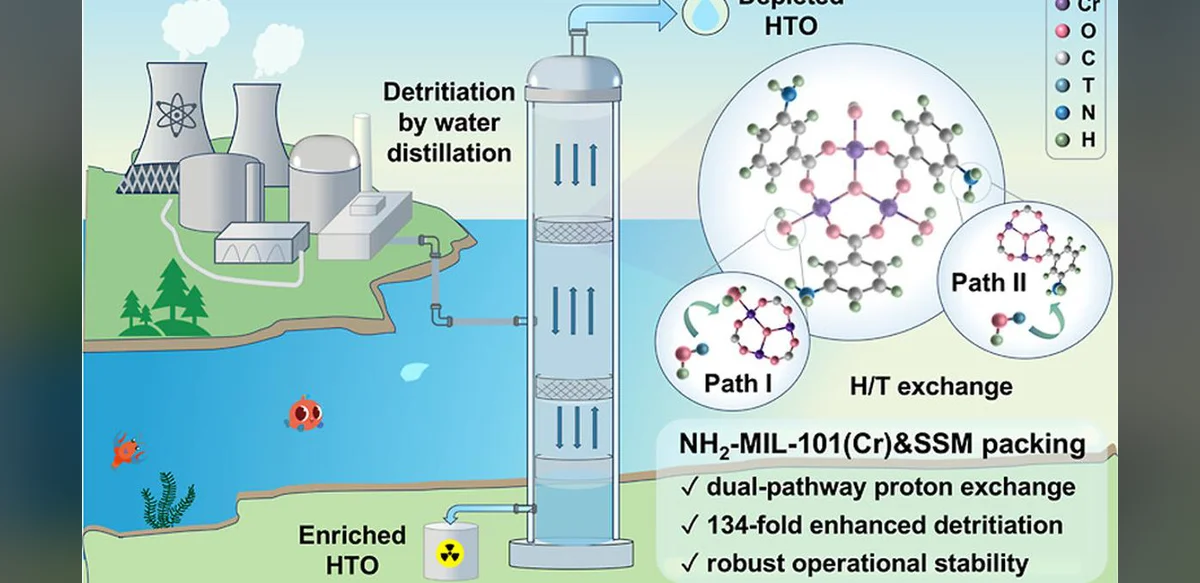
In 2023 Japan started a long-term release of treated wastewater from the damaged Fukushima nuclear plant into the Pacific Ocean. Most radioactive elements had been removed, but tritium remained. Tritium forms tritiated water that is chemically similar to ordinary water and hard to separate. Nuclear operators have usually diluted such water instead of removing the isotope. The released volume will be tiny relative to the Pacific, yet effects may be more noticeable near South Korea and China. Tritium can be absorbed by living organisms and spread through blood. A study in Environmental Science & Technology reports a metal-organic framework that improves tritium removal. Researchers from China used NH2-MIL-101(Cr) coated on stainless-steel mesh. The material greatly increases surface area and exchanges tritium atoms with ordinary hydrogen. Laboratory tests showed 42.5 theoretical plates per meter, far above previous packings. At industrial scale the new approach could be over 100 times more effective than current best materials and a million times better than standard commercial packings. The method may reduce tritium releases and support safer nuclear wastewater management.