


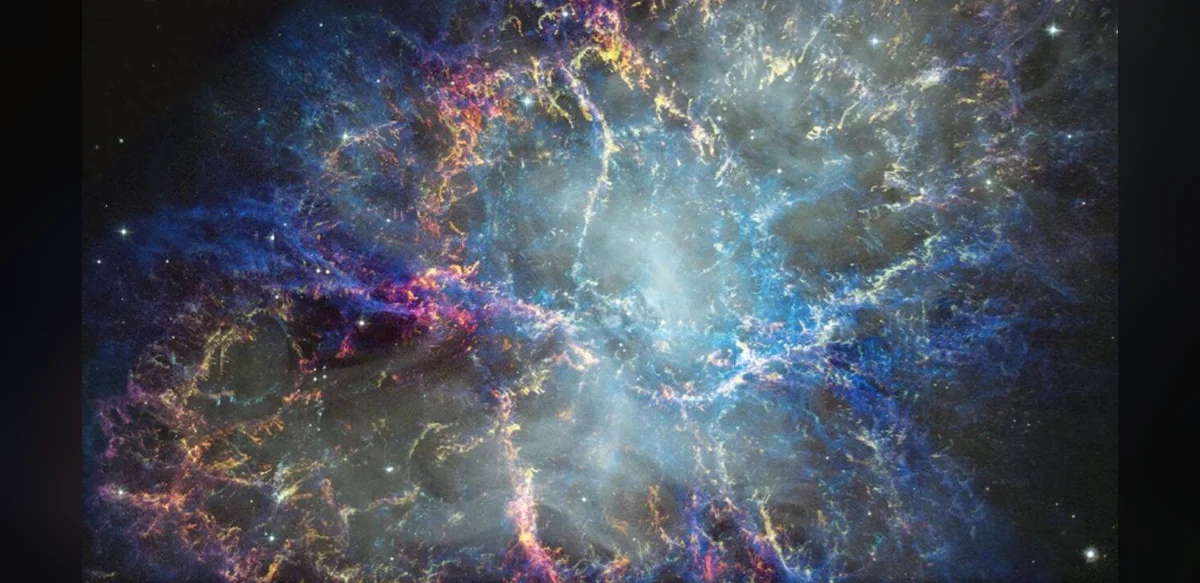
Nearly 1,000 years after a bright new star appeared in the sky, astronomers have measured the ongoing expansion of its remains. In July 1054, Chinese court astronomers noted a brilliant guest star near what is now called Zeta Tauri. The object shone brightly enough to be seen in daylight for about a month and remained visible at night for several months afterward.
The event was a supernova, the explosion of a massive star. The leftover cloud of gas and dust is known as the Crab Nebula. Using the Hubble Space Telescope, researchers compared recent images with those taken more than two decades earlier. The comparison revealed that filaments of gas continue to move outward.
Many celestial objects change too slowly to detect within a human lifetime. The Crab Nebula stands out because it is young, relatively close, and still active. The results appeared in The Astrophysical Journal.
The nebula lies roughly 6,500 light-years away in the constellation Taurus. It is also catalogued as Messier 1. Although the supernova was observed in 1054, the nebula was first seen through a telescope in 1731. Later observations helped distinguish it from comets.
Instead of monitoring the object over centuries, scientists compared Hubble images from 1999 and 2000 with new data from the telescope’s Cycle 31 mission. The high-resolution views showed that many outer filaments had shifted position over 24 years.
Some filaments display proper motions of at least 0.3 arcseconds per year. Despite the small angular shift, the gas travels at speeds around 5.5 million kilometres per hour. At the centre lies the Crab Pulsar, a neutron star spinning about 30 times per second. Its magnetic fields accelerate particles that produce the nebula’s blue glow, while older material forms the surrounding filaments.
The pulsar continues to supply energy, keeping the remnant dynamic. Additional comparisons with James Webb Space Telescope images helped examine gas, dust, and emission regions. Two previously unseen groups of filaments were also noted on opposite sides of the pulsar, though their origin requires further study.

