


Paleontologists working in China have found the oldest chemically verified amber on record, dating back 385 million years. This is roughly 140 million years before the first dinosaurs appeared. The earlier record was held by a sample from the Late Carboniferous, about 320 million years old.
Amber forms from fossilized plant resin, a sticky fluid released to close wounds and block infection. The find was made by Cihang Luo of the Nanjing Institute of Geology and Paleontology and his team in deposits of the Hujiersite Formation.
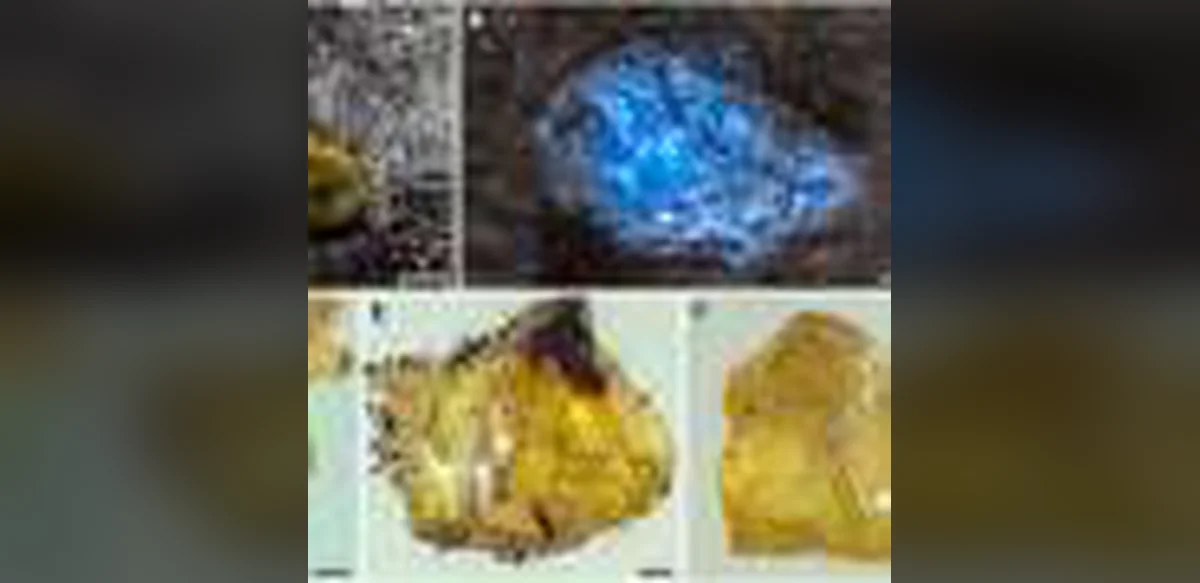
The group had not been looking for amber. They were gathering coal to examine ancient plants and the Middle Devonian environment. When they passed a UV light over the samples, bright blue fluorescence appeared, a common sign of amber.
The material occurred as hundreds of tiny fragments. From roughly 10 kilograms of coal the researchers recovered 241 pieces, most smaller than half a millimeter. Laboratory tests including infrared spectroscopy and gas chromatography-mass spectrometry showed the resin shares traits with modern conifer resins, though the exact plant group remains unknown.
The age was already known from earlier geological studies and fossil spores, placing the layer in the Middle Devonian about 385 million years ago. The authors state that this chemically verified amber is the earliest confirmed example found so far.
They suggest resin first evolved to help plants repair damage and endure harsh conditions. In the Devonian, threats included wildfires and parasitic fungi, so rapid sealing of wounds would have aided survival and supported the spread of early land plants.

