


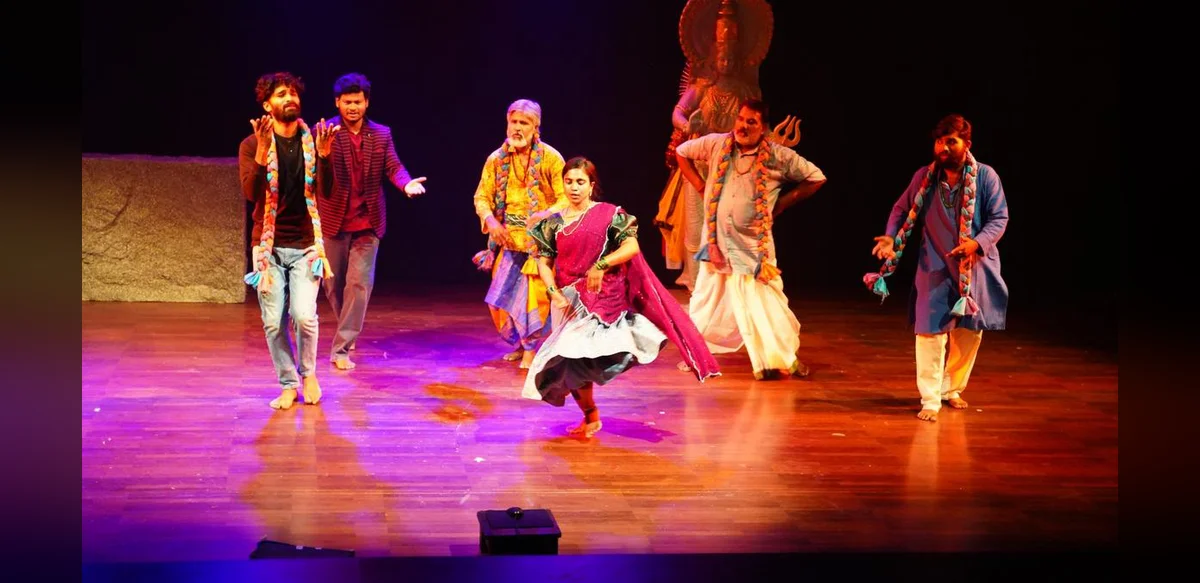
For three months, a rehearsal hall at Dr BR Ambedkar Open University in Hyderabad has hosted the 15-member ensemble of the Janapadam Modern Travelling Theatre Repertory. The group has prepared Neelaveni, a new Telugu play presented at Ravindra Bharathi.
Director Srinivas Denchanala notes that Neelaveni examines the tension between unconditional love and physical desire. The work also challenges traditional views of male-female relations and highlights neglected communities through political themes.
Credits list both Denchanala, who serves as poet, playwright, actor, critic, designer and director, and the late playwright Gollapudi Maruthi Rao. Denchanala explains that the play draws its central idea from one of Gollapudi’s works about blind people living together, prompting the shared credit.
Over four decades, Denchanala has employed theatre to represent those without a platform. His troupe’s 64 productions have aimed to develop local talent, draw on regional imagination and reflect the experiences of communities outside mainstream attention.
His NGO Janapadam, meaning countryside in Telugu, has operated for 42 years in theatre, folklore, culture and literature. Registered as a social and cultural society, the repertory has performed in towns, villages and tribal areas of Telangana and Andhra Pradesh, as well as national and international festivals.
Through work with marginalised castes and groups, the company uses contemporary theatre to prompt questions about social, economic, cultural, environmental and gender-based oppression, Denchanala says.
Raised in an artisan family in Krishnapuram, Khammam district, Telangana, Denchanala continued his interest in theatre after intermediate studies by performing in leftist productions and festival plays. In 1989 his work was the sole Telugu entry in a Sangeet Natak Akademi festival in Hyderabad alongside pieces by Habib Tanvir and Girish Karnad.
He describes the event as pivotal, revealing modern Indian theatre as a blend of Western realism and indigenous forms. His productions integrate music, choreography, masks, lighting and space with dialogue, employing local traditions to explore modern and postmodern questions.
Despite scarce resources, Denchanala persists. Each new production brings doubts, yet he restarts because of his own grassroots origins. His aim remains bridging rural-urban gaps and linking marginalised communities to opportunities via theatre.

