


The move represents China’s clearest effort yet to assume a leading role in artificial intelligence on the world stage.
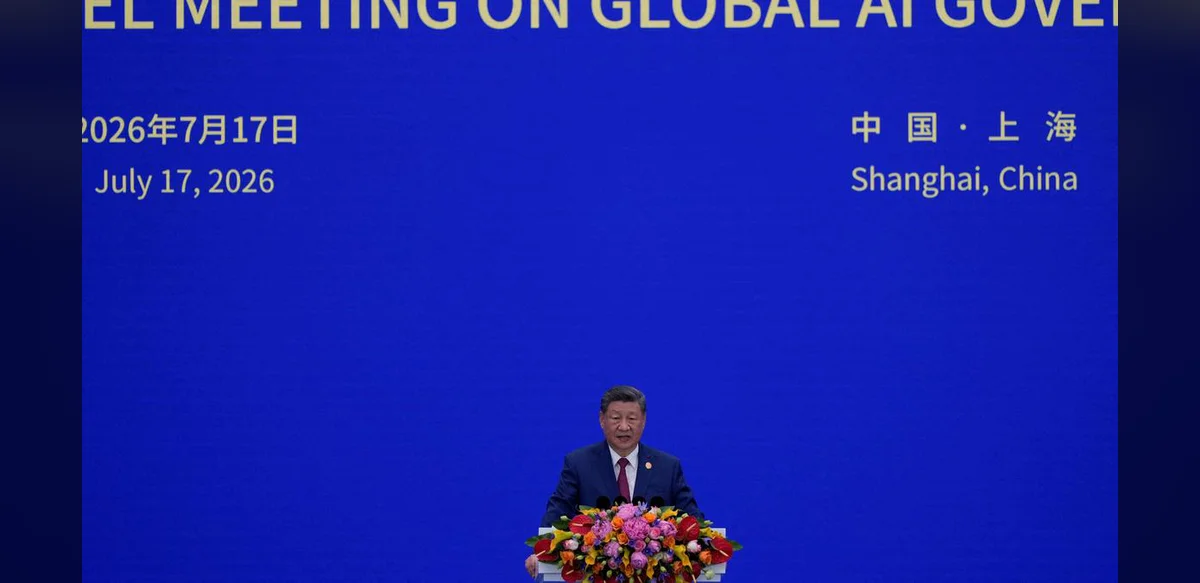
On Friday, Chinese President Xi Jinping introduced a fresh proposal for worldwide AI oversight, directed mainly toward developing nations. China and 29 other countries, primarily from Asia, Africa and Latin America, have created the World Artificial Intelligence Cooperation Organisation, headquartered in Shanghai.
Xi presented the plan as a significant Chinese response to requests from the Global South, aimed at fostering joint progress in AI development and regulation. He called it a landmark moment in the evolution of the technology during an AI governance summit held in Shanghai.
Over the coming five years, China will offer developing countries 5,000 training and seminar slots in AI, while establishing joint application centres with ASEAN, the League of Arab States, the African Union, the Community of Latin American and Caribbean States, the Shanghai Cooperation Organisation and BRICS.
China’s broader aim includes building alternatives to Western AI systems and promoting them in developing markets. Officials in Beijing worry about security risks tied to reliance on models developed in the West.
Xi urged nations to reject the excessive use of national security arguments in AI and to avoid prioritising one country’s safety above others. Although the United States went unnamed, Chinese representatives have previously criticised Washington for treating technologies such as AI as security matters.
Shortly before the organisation’s launch, Chinese firm Moonshot revealed its Kimi K3 model, whose performance drew attention from Western observers. Companies including Moonshot and DeepSeek supply open-source models that Beijing views as advantageous for nations adopting AI. Xi emphasised support for open-source approaches, openness, collaboration and sharing.
Beyond security, Chinese officials have raised concerns about what they describe as the spread of Western values via AI platforms and resulting losses of sovereignty. This message is expected to appeal to many countries in the Global South.
Xi stressed the need to nurture diverse civilisations so their unique qualities are recognised and exchanged, noting that AI progress should involve collective international effort rather than dominance by any single nation.
Founding members of the new body include Brazil, Russia, South Africa, Indonesia, Kazakhstan, Kenya, Malaysia, Pakistan, Uzbekistan and Venezuela. India attended the Shanghai summit with a Joint Secretary-level delegation yet remains the only founding BRICS nation not joining the organisation. It now faces questions over how to respond as China seeks to expand the initiative within BRICS and the SCO, groups that include India.

