


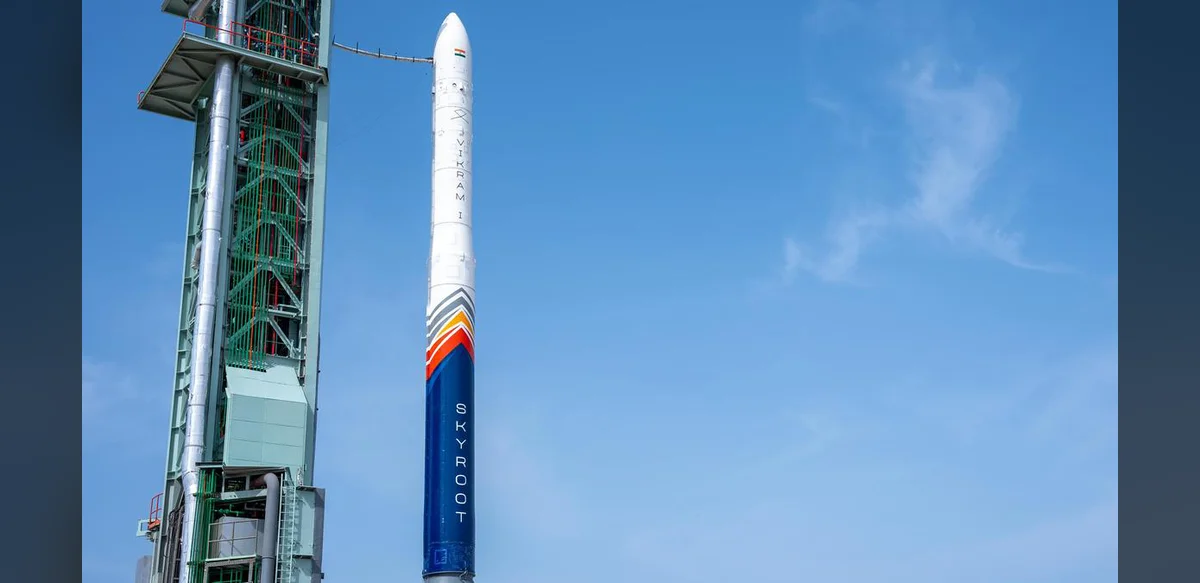
Vikram-1, India’s first privately built orbital-class rocket, is scheduled to launch from the Satish Dhawan Space Centre in Sriharikota on July 18, 2026, at 11:30 a.m. The flight is expected to signal the arrival of Indian private firms in the international launch services sector.
The vehicle was created by Hyderabad-based Skyroot Aerospace and has obtained all required approvals for its first mission, called Mission Aagaman. This marks the initial effort by an Indian private company to send an orbital-class rocket into space. Authorities have released airspace and maritime notices that establish restricted areas along the flight path and impact zones.
Vikram-1 is built to deliver small satellites of up to 350 kg into low Earth orbit. Its debut flight aims for a 450 km altitude at a 60-degree inclination. The seven-stage vehicle uses an all-carbon composite frame and relies on domestically developed solid and liquid engines, including 3D-printed components and high-thrust boosters. It is engineered for fast production and frequent launches. The sequence from liftoff to orbit insertion includes 14 stages and should take 15.46 minutes.
Skyroot Aerospace received launch clearance from the Indian National Space Promotion and Authorisation Centre. All stages have been assembled and stacked on the pad, with final system checks completed at the company’s control center along with ground station and radar interfaces.
The rocket will carry technology demonstration payloads from Grahaa Space, Cosmoserve, DCubed and Skyroot’s SCOPE instrument. It will also transport Cosmos Diamonds’ Cosmic Bloom artwork and a micro-art piece. Cosmic Bloom consists of diamond jewelry on an aluminum plate. The micro-art, made by Ajay Kumar Mattewada, features an 18-carat gold rocket holding tiny sculptures of three Indian scientists inside a needle’s eye. An international payload from Germany-based DCubed is included as well.
The Embrace payload from Cosmoserve Space features a robotic arm that will stay fixed to the payload deck during its test. The demonstration seeks to show soft robotic capture in orbit for the first time, advancing orbital cleanup methods and underscoring the expanding role of India’s private space industry.

