


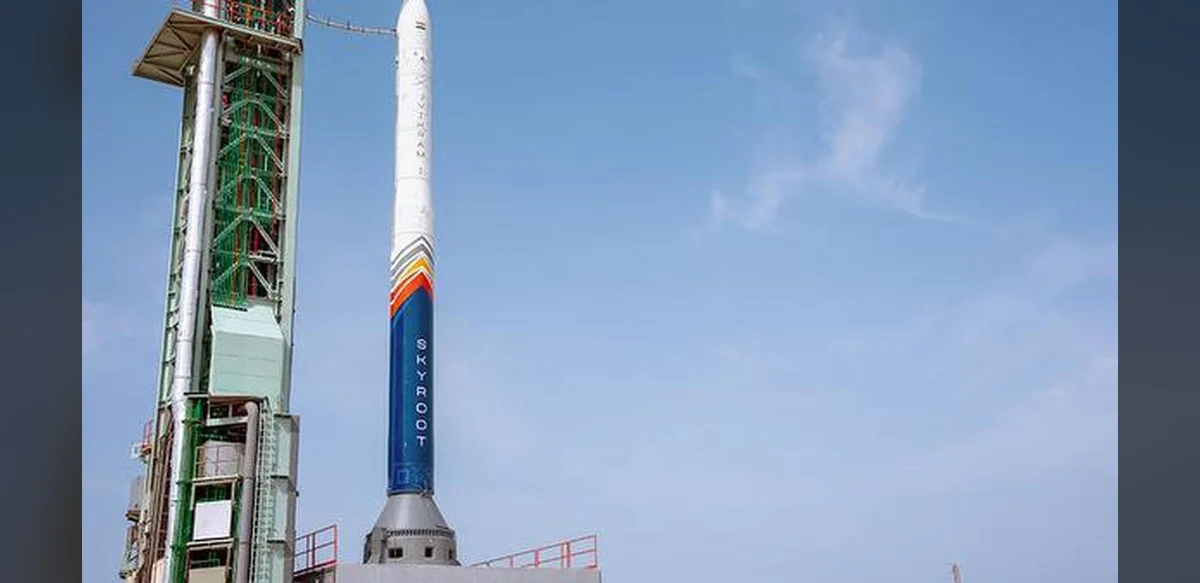
Vikram-1, carrying technology payloads and commemorative postcards, lifted off from the Satish Dhawan Space Centre at Sriharikota on Saturday, July 18, 2026. The launch had been briefly delayed earlier in the day before a revised schedule was set, with liftoff occurring at 12:05 p.m.
The vehicle was built by Skyroot Aerospace. Five minutes before the initial planned launch, the company announced a planned hold. The automated launch sequence had started about ten minutes prior, allowing onboard systems to manage the countdown and checks. After the hold, the sequence restarted and the rocket lifted off at the new time.
Vikram-1 is a seven-storey-tall, multi-stage orbital launch vehicle featuring an all-carbon composite structure and propulsion systems developed in-house, including 3D-printed engines and high-thrust solid-fuel boosters. It is designed to deliver small satellites of up to 350 kg to low Earth orbit. The test flight targeted a 450 km orbit at 60 degrees inclination and carried six technology demonstration payloads plus artwork and a micro-art piece.
Skyroot received launch authorisation from the Indian National Space Promotion and Authorisation Centre. All stages were integrated and stacked, with final checks completed from the company’s launch control centre and interface verifications performed with ground stations and radars.
The primary goal of the first test flight, called Mission Aagaman, was to achieve liftoff, clear the tower safely and collect extensive data during ascent. The flight sequence included 14 phases over 15.46 minutes. The mission follows Skyroot’s earlier suborbital flight of Vikram-S in 2022. The company described the flight as partially commercial, with full commercial operations planned after one or two successful orbital demonstrations.
The rocket stands 22 metres tall with a 1.7 metre diameter and uses three solid stages plus a liquid orbital adjustment module. Payloads include contributions from several organisations. Vikram-1 marks several national firsts for a private orbital vehicle, including an all-carbon composite structure, a fully 3D-printed engine and ultra-low-shock separation systems.
The launch occurred 46 years after India’s first experimental satellite launch vehicle lifted off from the same site in 1980. A handwritten postcard from the prime minister and other cards also travelled aboard the rocket.

