


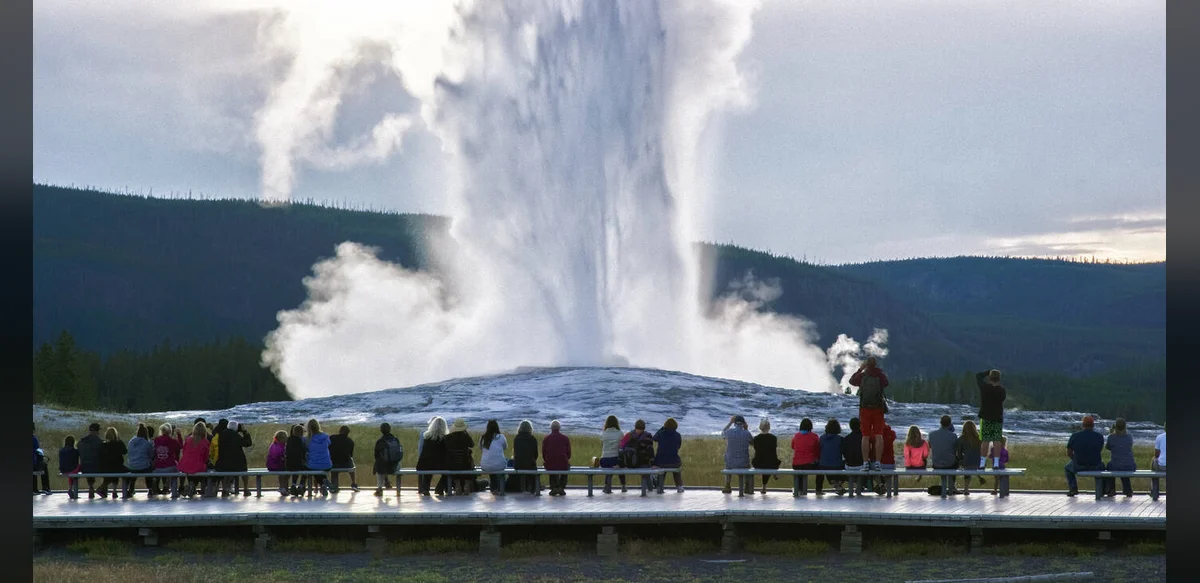
A large group watches Old Faithful erupt in Yellowstone National Park on a cloudy day.
What defines a geyser and why do they occur so infrequently?
How Old Faithful received its lasting name during the 1870 expedition
Why the geyser no longer erupts on a perfectly fixed schedule
Why Old Faithful continues as Yellowstone’s leading emblem
Note: This piece serves educational purposes. Facts draw from the U.S. Geological Survey, Yellowstone Volcano Observatory, and National Park Service.
Yellowstone gained renown for natural features formed deep underground rather than human construction. During summer 1870, explorers in the area that became the national park observed a tall jet of scalding water rise high. Roughly an hour later the same event repeated. The steady pattern led them to call it Old Faithful.
More than 150 years later the geyser still erupts daily and attracts millions of tourists. It ranks as the park’s top draw and a prime illustration of geothermal energy.
A geyser differs from an ordinary hot spring and ranks among Earth’s scarcest formations. The USGS reports fewer than one thousand active geysers globally, over half located inside Yellowstone.
Three conditions must align: intense subsurface heat from the park’s volcanic system, groundwater reaching deep fractures, and narrow rock channels that trap water under high pressure. Superheated water then forces steam upward in a visible eruption.
Indigenous groups knew the geothermal zones for centuries, though written accounts are scarce. Obsidian artifacts near the Upper Geyser Basin confirm long-term use before European arrival.
The first formal record of Old Faithful dates to the 1870 Washburn-Doane-Langford Expedition. Nathaniel P. Langford noted nine eruptions with heights of 90 to 125 feet lasting 15 to 20 minutes. He recorded the name “Old Faithful” due to its regularity.
Geologist Ferdinand V. Hayden later highlighted its steady behavior as useful for study, aiding the park’s creation in 1872.
Visitors today expect exact timing, yet intervals have shifted slightly. Early records showed eruptions every 60 to 70 minutes; the current average is about 94 minutes with a 10-minute range.
Earthquakes in 1959, 1975, and 1983 lengthened intervals by altering underground channels. Rainfall also affects timing, with wetter periods shortening waits.
Old Faithful is neither the tallest nor largest geyser in the park, yet its dependable character keeps it the most recognized landmark.

