


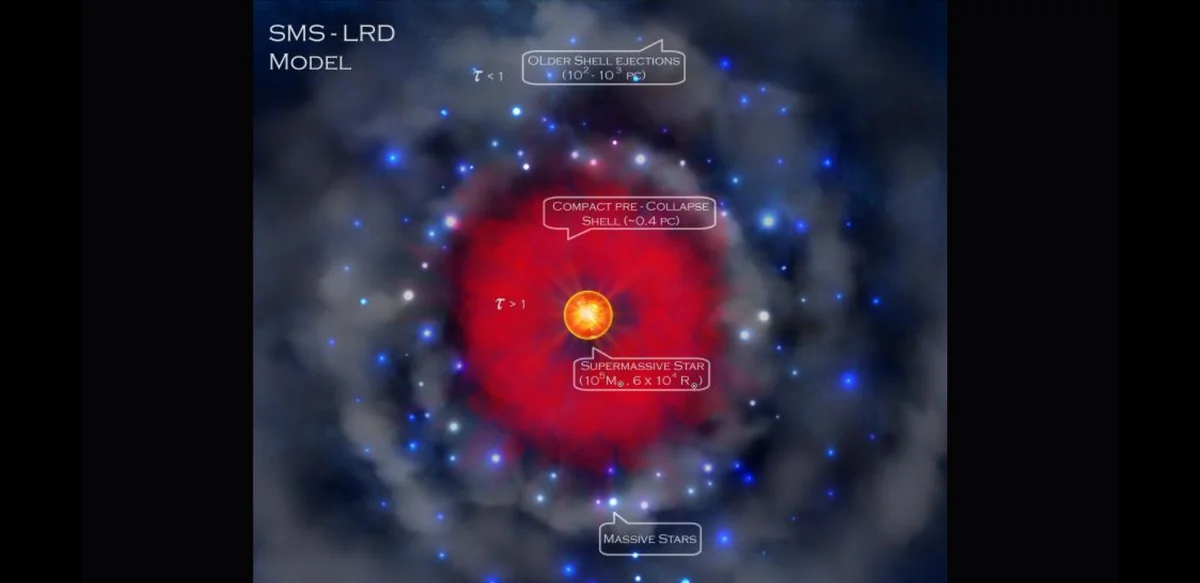
Mysterious compact objects seen in the early universe may be enormous stars up to 100,000 times the Sun’s mass. A study from the Center for Astrophysics | Harvard & Smithsonian proposes these stars account for the odd traits of the ‘little red dots’ found by the James Webb Space Telescope. Their collapse might also clarify how the first supermassive black holes appeared less than a billion years after the Big Bang.
Led by Devesh Nandal, the research offers one model that fits the objects’ light spectrum, small size, and chemical makeup. It is the first such model to address multiple observed features together, including spectra, shape, and chemical signs. Other ideas now also point to supermassive stars as the central source.
The objects appeared in deep images from the telescope and earned their name from their small size and red glow in infrared. Their light patterns have not fit prior models. Proposed explanations include young galaxies, growing black holes, hypothetical quasi-stars, intense star-forming zones, or an unknown cosmic type.
Active galaxies with feeding black holes usually emit strong X-rays and radio waves, yet these dots stay faint or undetected in X-ray data. They combine traits that rarely align, hinting at a bright source inside dense gas. Telescope readings also show unusual hydrogen patterns and high nitrogen levels.
Prior work indicated that primordial stars of about 100,000 solar masses could produce similar hydrogen signs. The new model examines how such stars evolve and lose mass. Unlike typical stars, they undergo repeated violent pulsations that eject large gas shells, forming a compact cocoon matching telescope observations.
The shells consist mainly of hydrogen and helium with high nitrogen, aligning with recent data on the dots. This supports the supermassive star idea. The model may also address how supermassive black holes grew so early, as these stars burn fuel fast and collapse directly into heavy seed black holes of tens of thousands of solar masses.
Researchers plan to refine the model for more detailed spectra to allow future telescope tests of whether these stars preceded the first giant black holes.

