


Louise Martin-Chew, The University of Queensland
The term avatar often brings to mind James Cameron’s blue Na’vi characters. Cameron drew partial inspiration from the incarnations of the Hindu deity Vishnu, who appeared on earth to maintain cosmic balance.
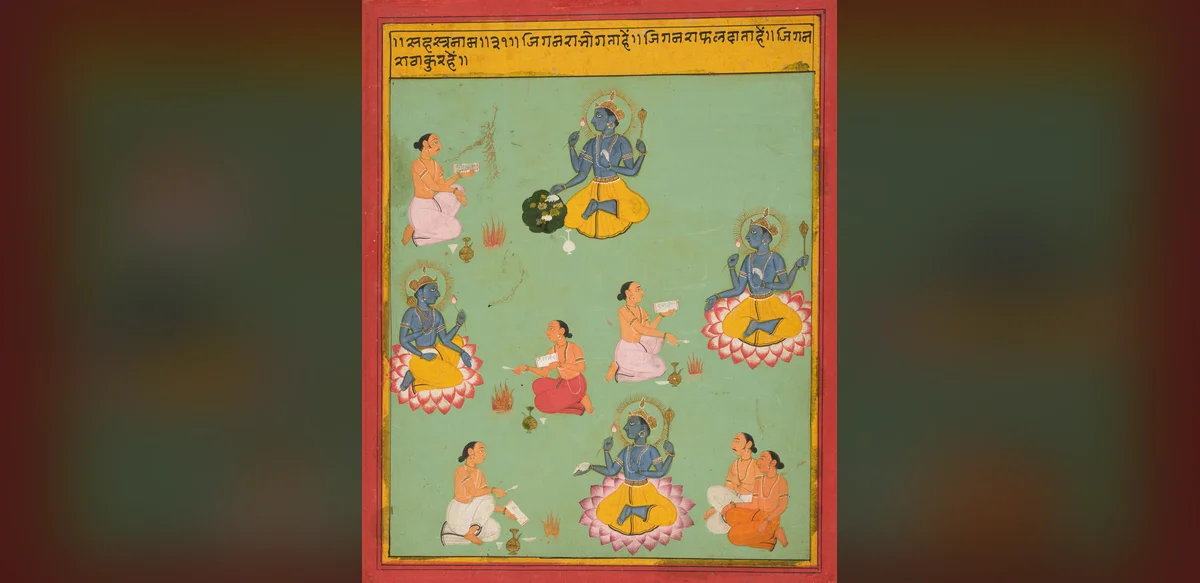
For more than fifteen centuries Vishnu has been revered as a preserver of dharma, order, morality and righteousness, appearing in ten or more human and animal forms. Artists usually portray him with blue skin to signify his distance from mortals, evoking the cosmos and, in his Krishna form, the hue of monsoon clouds.
The exhibition Avatar: Forms of Vishnu at the Art Gallery of New South Wales draws on these traditions. It features two hundred works spanning fifteen hundred years, borrowed from collections in Australia and abroad. Several pieces, including early Cambodian sculptures, are travelling outside their home countries for the first time.
The finely made objects present mythological stories that highlight Vishnu’s enduring role in Hindu cultures and their relevance to present-day Australia. Contemporary pieces complement the historic ones, showing how tradition continues in current practice.
The Sanskrit word avatāra means descent. Co-curator Chaitanya Sambrani described Vishnu as a holistic presence, everywhere and in everyone, existing beyond organised religion. The three-year project feels timely. In an era of political division, environmental strain and identity debates, Vishnu’s manifestations that restore order from chaos appear especially relevant.
The lasting power of these narratives appears in the mix of old and new works across textiles, carvings, gold, embroidery, paintings, bronze and watercolours. An eighth-century Cambodian sandstone figure shows a four-armed Vishnu holding symbolic objects. Two large recent paintings by Desmond Lazaro accompany it, illustrating the churning of the ocean of milk.
A thirteenth-century Indian soapstone carving of the man-lion avatar is paired with a modern textile installation. The show also notes the importance of female consorts in enabling Vishnu’s tasks. The final section, Vishnu’s Cosmos, includes a painted portable shrine and embroidered prints from the Ravi Varma Press.

