


Mridula Nath Chakraborty, Monash University
In 2022, Tomb of Sand became the first Indian work to receive the International Booker Prize. Written in Hindi by Geetanjali Shree and translated by Daisy Rockwell, the book represents the peak of her literary career.
Previous Indian winners of the Booker Prize, limited to English-language books, include Salman Rushdie in 1981, Arundhati Roy in 1997, Kiran Desai in 2006 and Aravind Adiga in 2008. English is used by roughly 10 percent of India’s population, its status shaped by two centuries of British colonial rule.
Hindustani, commonly called Hindi, has between 611 million and 855 million speakers globally. Despite this reach, Hindi literature and works in India’s 22 other official languages receive limited international attention due to the dominance of English-language publishing.
Shree addressed this issue in an early story, Pilaki Mane Faye. A character notes the financial advantage of writing in English, observing that the British Empire may have ended in name only. Another writer earns a rupee per word for English articles, prompting reflection on the disparity.
Over five short-story collections and five novels, Shree has examined the postcolonial relationship between Hindi and other Indian languages and English. Since her first story appeared in the magazine Hans 40 years ago, she has challenged conventional forms and linguistic hierarchies.
Until the Booker win, her work remained largely unknown outside India.
Language as homeland
Hindustani developed between the 7th and 13th centuries under Muslim rule. It exists in two mutually intelligible forms: Hindi, rooted in Sanskrit, and Urdu, influenced by Arabic and Persian. This hybrid language has been viewed as a bridge across religious and social lines.
Shree blends literary Hindi with Khari Boli, the everyday rural speech of northern India, particularly Bhojpuri dialects. Her childhood moves across Uttar Pradesh towns, following her father’s civil-service postings, gave her deep familiarity with these variations.
Educated in English-medium institutions, Shree began writing in Hindi almost by chance, drawn by the language she heard around her. She regards language not as a simple instrument but as an entity with its own character. In her view, it serves as homeland, memory and form of protest, something inherited yet continually reshaped.
Her writing critiques English dominance while acknowledging the opportunities English education provides. The strength of her work lies in its grounding in vernacular speech and inventive style.
Contesting narratives
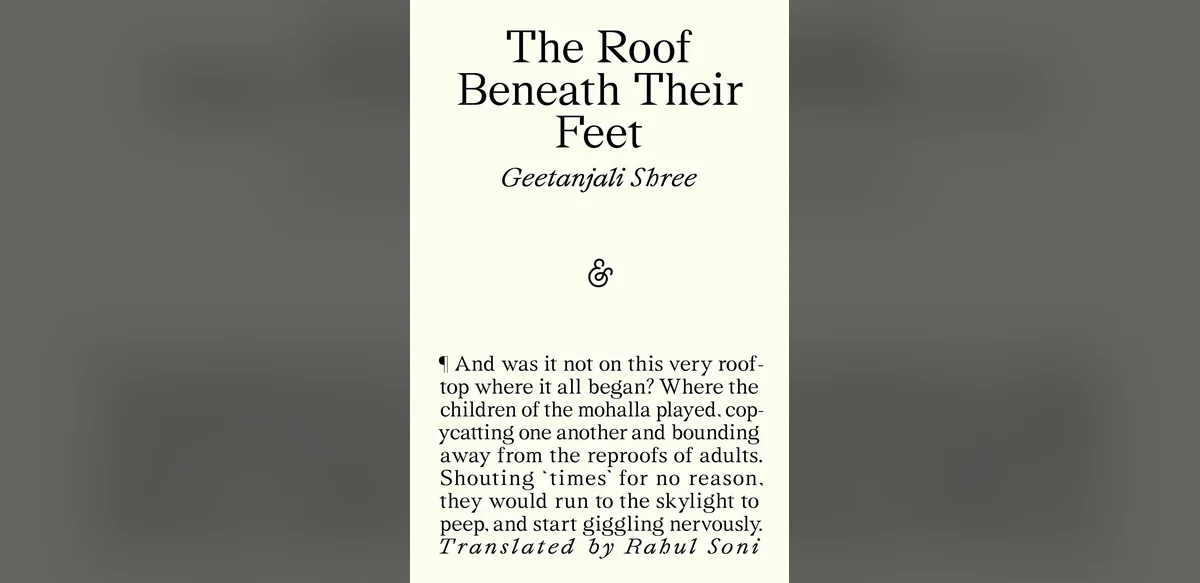
The Roof Beneath Their Feet, translated by Rahul Soni and first published by Penguin India in 2013, has been reissued in an international edition. The novel is set in Laburnum House, described as a vast building containing about a hundred homes beneath a rolling roof. The first half is narrated by a young man grieving the death of an aunt who may have been his mother and resenting her friend Lalna. The second half continues the story.

