


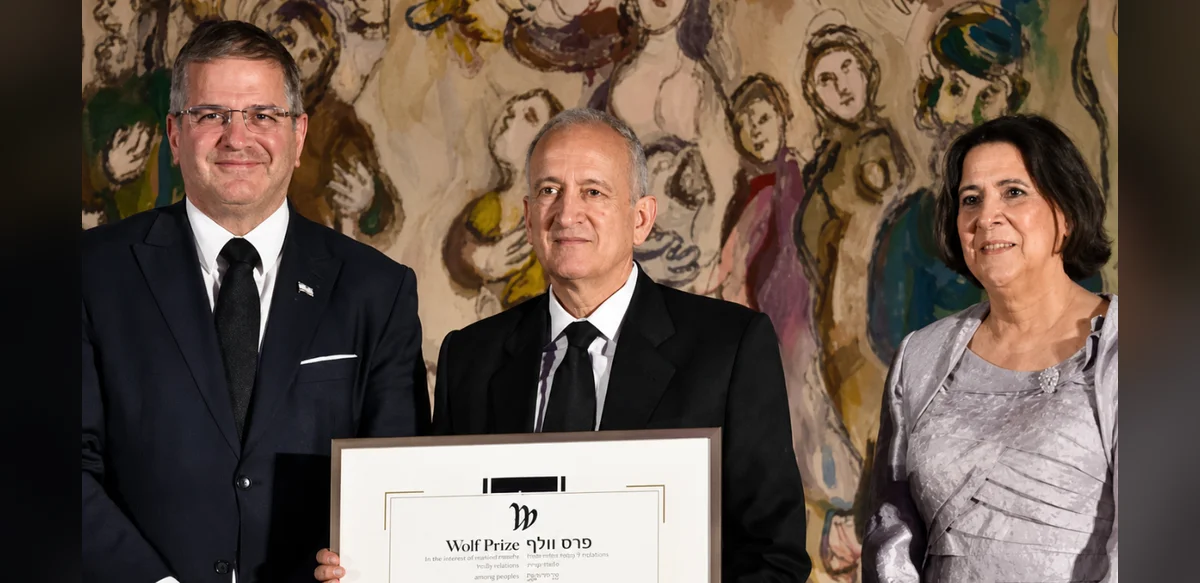
Jainendra K. Jain’s composite fermion theory earned him the Wolf Prize
A theory that kept growing
From a village in Rajasthan to the frontiers of science
Jain’s work beyond awards and recognition
In theoretical physics, some ideas solve a problem while others reshape an entire field. Jainendra K. Jain’s theory of composite fermions belongs in the second category. Born in rural Rajasthan and now the Erwin W. Müller Professor of Physics at Pennsylvania State University, Jain has spent much of his career addressing questions at the edge of understanding. His work has influenced generations studying quantum matter, and in 2025 it earned him the Wolf Prize in Physics. He became the first physicist of Indian origin to receive the award.
His achievement reflects decades of research into electron behaviour under extreme quantum conditions. By introducing composite fermions, Jain provided a framework for explaining the fractional quantum Hall effect, a phenomenon that had puzzled physicists. The theory resolved longstanding questions and opened new directions in condensed matter physics.
The Wolf Prize is regarded as one of the highest distinctions in science. Jain was recognised for his explanation of the fractional quantum Hall effect, discovered in the 1980s. Electrons in ultra-thin layers under strong magnetic fields showed conductance in fractions rather than whole numbers. In 1989, Jain proposed that electrons bind with magnetic flux quanta to form composite fermions. This transformed a complex problem into one explained by familiar principles.
Today, many observed quantum Hall states are interpreted through composite fermion theory. Terms such as Jain states have entered the field’s vocabulary. More than three decades later, the theory remains central to research on topological phases, anyons, and correlated electron systems. Many predictions were later confirmed experimentally. The Wolf Foundation awarded Jain the 2025 prize alongside James P. Eisenstein and Mordehai Heiblum.
Jain grew up in Rajasthan. As a child, an accident left him with a lifelong disability requiring a prosthetic limb. He later reflected that growing up in a poor village, he did not expect to attend college or pursue physics.

