


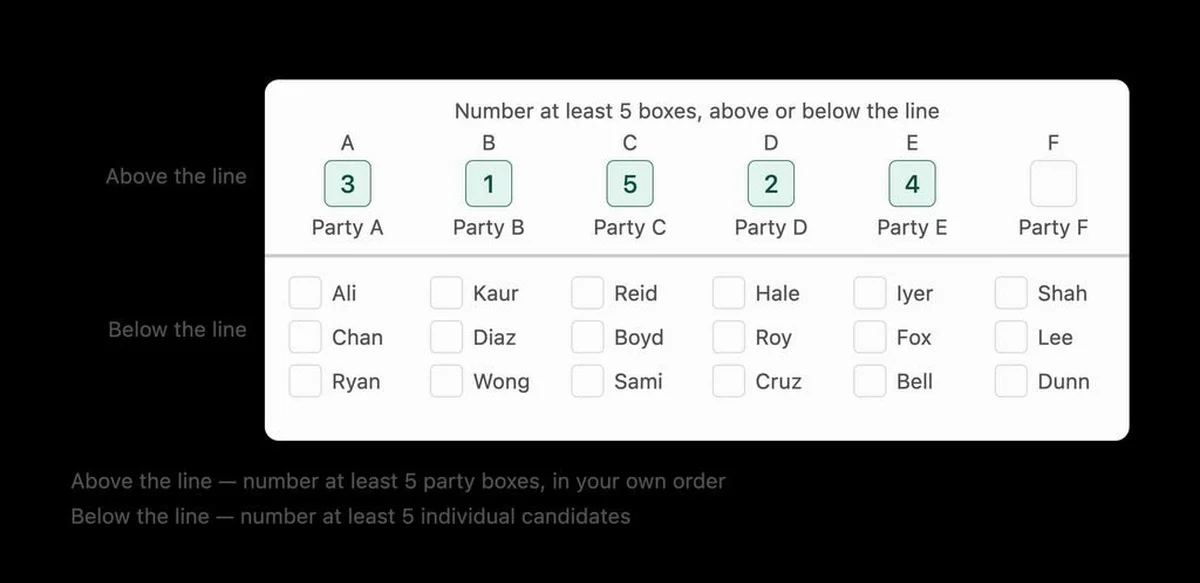
Voters heading to the polls for Victoria’s Legislative Council on 28 November will encounter a ballot paper that differs from those used in all prior state elections. The change stems from legislation passed in August that eliminates group voting tickets, a system previously allowing parties to direct preferences on behalf of voters. The Electoral Amendment (Miscellaneous Matters) Act 2026 received royal assent after clearing both houses of parliament, marking a significant shift in how upper house seats are allocated.
Under the former arrangement, voters could either number every candidate individually or select a single party group above the line, after which preferences flowed according to pre-lodged tickets. Critics argued that these tickets often produced outcomes that did not reflect voter intent, as deals struck between parties determined the final distribution of votes. The new rules require voters who choose the above-the-line option to number at least five party groups, with preferences then distributed according to those numbers rather than party agreements.
The reform was introduced on 28 July and moved swiftly through the lower house before securing passage in the upper house. Supporters of the change described it as restoring greater control to individual voters and reducing the influence of backroom negotiations. Opponents raised concerns about increased informal voting and the complexity of requiring voters to rank multiple groups.
Electoral officials have launched an information campaign to explain the updated process. The Victorian Electoral Commission has distributed explanatory materials and updated its website with sample ballots and step-by-step guides. Training for polling staff has also been adjusted to handle questions about the new numbering requirements.
Political analysts note that the absence of group voting tickets is likely to produce a more fragmented result in the Legislative Council. Minor parties that previously benefited from preference flows may find it harder to secure seats without broad voter support. Major parties, meanwhile, are adjusting campaign strategies to encourage supporters to rank multiple groups in line with party recommendations.
The legislation applies only to Legislative Council elections and does not affect voting for the Legislative Assembly. Candidates and parties must still register how-to-vote cards, but these cards can no longer rely on the group ticket mechanism. Observers expect the first election under the new system to provide data on whether informal vote rates rise and how preference distributions differ from previous contests.
Public response has been mixed. Some voters welcome the opportunity to express more nuanced preferences, while others worry about the added time required to complete the ballot. Community organisations have begun running information sessions in suburban and regional areas to familiarise residents with the changes ahead of election day.
The reform aligns Victoria with several other Australian jurisdictions that have already moved away from group voting tickets. Electoral commissions in those states reported initial increases in informal voting that later declined as voters became accustomed to the new format. Victorian officials are monitoring those experiences to refine their own education efforts.
As the election approaches, candidates across the political spectrum are emphasising the importance of understanding the updated ballot. The Victorian Electoral Commission continues to urge voters to check their enrolment details and review sample ballots online. The outcome on 28 November will serve as the first test of whether the removal of group voting tickets produces results that more closely mirror direct voter choices.


