


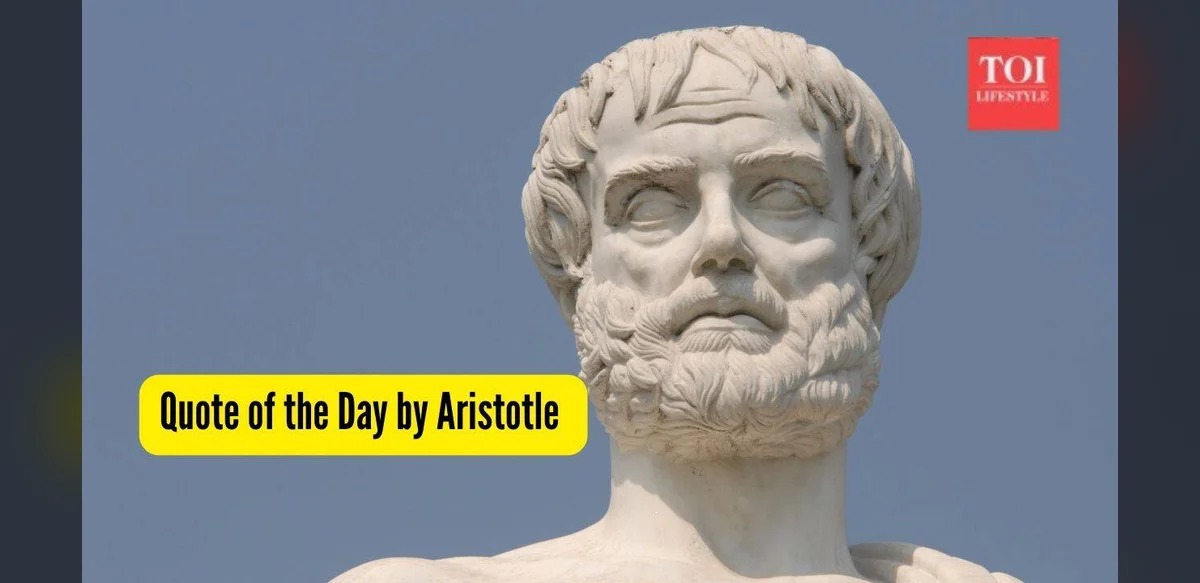
Aristotle Quote of the Day
His Ideas
Aristotle’s Influence Across Time
Quote of the Day
A well-known statement attributed to Aristotle carries deep significance: “The main aim of men who are wise is not just to secure pleasure in life but to try and stay away from things that can cause pain.”
Aristotle ranks among history’s foremost thinkers. His contributions shaped philosophy, science, politics, ethics, education and formal logic. While many thinkers focused on abstract concepts, he believed wisdom should improve daily existence. More than two millennia later, his thought continues to guide educational institutions, governments and research.
Born in Stagira in northern Greece in 384 BC, Aristotle grew up in a medical household. His father served as physician to the Macedonian court, giving the young man early exposure to empirical observation and biology.
At seventeen he traveled to Athens and entered Plato’s Academy, remaining nearly twenty years. Although he admired his teacher, he often differed with Plato’s emphasis on ideal forms, preferring knowledge grounded in direct observation of the physical world.
After Plato’s death, Aristotle traveled and conducted studies. Around 343 BCE, King Philip II invited him to tutor his son, later known as Alexander the Great. Upon returning to Athens, Aristotle established the Lyceum, where systematic inquiry into biology, astronomy, politics, literature, ethics and logic took place. Students gathered extensive data on plants, animals and constitutions.
Following Alexander’s death in 323 BCE, rising anti-Macedonian sentiment prompted Aristotle to leave Athens. He settled on the island of Euboea and died there in 322 BCE at age sixty-two.
Aristotle viewed happiness not as mere pleasure but as eudaimonia, or human flourishing achieved through virtue, wisdom and purposeful living. He proposed the Golden Mean, locating virtue between harmful extremes such as cowardice and recklessness or selfishness and wastefulness.
He also stressed practical wisdom, or phronesis, enabling sound decisions that combine reason, experience and moral character. Humans, he argued, are inherently social beings who reach their potential within family, friendship and community, famously describing people as political animals.
For roughly two thousand years his logical framework underpinned rational inquiry in philosophy, mathematics and science. His biological studies involved careful classification of numerous species.
Few individuals have shaped civilization as profoundly. His writings influenced ancient Greece, Rome, medieval Europe, the Islamic Golden Age and the Renaissance. Islamic thinkers such as Avicenna and Averroes preserved and expanded his works, ensuring their transmission to later generations.

