


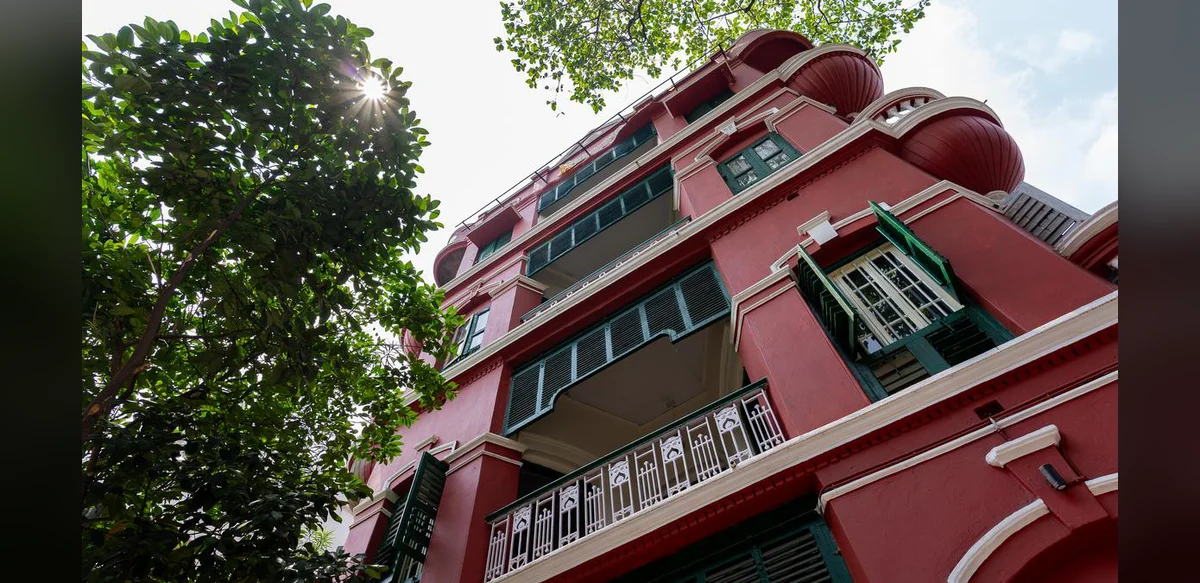
Kolkata’s old heritage structures stand against the skyline like solid notes from an ancient organ. Their rise and fall create the city’s distinct sound, blending memory, loss and renewal.
The 109-year-old Royal Insurance Building in Dalhousie Square, opposite the GPO, long served routine government functions. It shows early 20th-century colonial commercial design with Edwardian and Classical details in its size and decoration. On March 27, however, the building took on a new role. Neon pink and blue lights lit its old stairwells while flamenco dancers in heels waited on the steps for their show.
The change came from Kolkata Unforgettable, an experiential tourism project run by Shailaja Mundra and her daughter Vasudha Pachisia. While studying the city’s heritage sites, the organisers saw these structures as ready-made settings for cultural programs. They noted that owners often lack funds to maintain aging properties. Their answer was to stage fortnightly immersive performances that could draw public interest and income.
“Dalhousie, the downtown area, stays quiet on weekends despite its rich architecture,” says Vasudha. Instead of formal history talks, the team mixes storytelling, music and dance, letting the building itself take center stage. Earlier events featured a play on the GPO’s past, a dastangoi show on Guru Dutt inside a North Kolkata mansion, and a concert at St. John’s Church that used the rarely played pipe organ with a choir and strings.
At the Royal Insurance Building, choreographer Soujit Das and his Beatbusters group turned the staircase into a performance area. Audiences moved between floors as the show happened around them. Between acts, art walker Navpreet Arora shared the building’s history. “These are not standard halls. We must use imagination and treat every space as a stage,” Vasudha says. The events, held every few weeks, aim to become self-sustaining, with some revenue going toward upkeep of the buildings.
Across Kolkata, old walls now support new uses such as jazz bars, cultural spots, cafés and performance venues. Owners view restoration as ongoing life rather than mere nostalgia.
Adaptive Reuse
Munir Mohanty, co-founder of Skinny Mo’s jazz bar, follows the same approach. He owns the 109-year-old late colonial building on South Kolkata’s Manoharpukur Road. It holds two popular spots: Nutcase cocktail lounge and Skinny Mo’s jazz bar, which shares space with a thrift shop.
Munir grew up on Camac Street and later studied in the United States. He returned to Kolkata in 2017 seeking a venue for jazz and vinyl records. After buying the building in 2019, he spent a year on restoration. “I removed all sewage pipes, wiring and plaster inside and out until only the brick shell remained. Damp issues needed fixing, then soundproofing followed. We avoided glass and used aluminium windows, kept the red oxide floors and sourced tiles from Bikaner,” he explains.
Architect Aishwarya Tipnis and co-founder Hinna Devi Singh launched Jugaadopolis to assist owners with restoration and material sourcing. The open-source project draws on circular economy ideas to help people conserve heritage buildings themselves.
“Most owners are affluent and have studied or lived abroad. Examples include Red Bari, a café in a 90-year-old Kalighat building, and Bombaim, a high-end boutique in a century-old bungalow nearby,” says Aishwarya.
Red Bari features bright red walls, curved balconies, khorkhori windows, red oxide floors and wooden shutters, typical of traditional Bengali urban homes with courtyards, verandahs and shuttered windows.

