

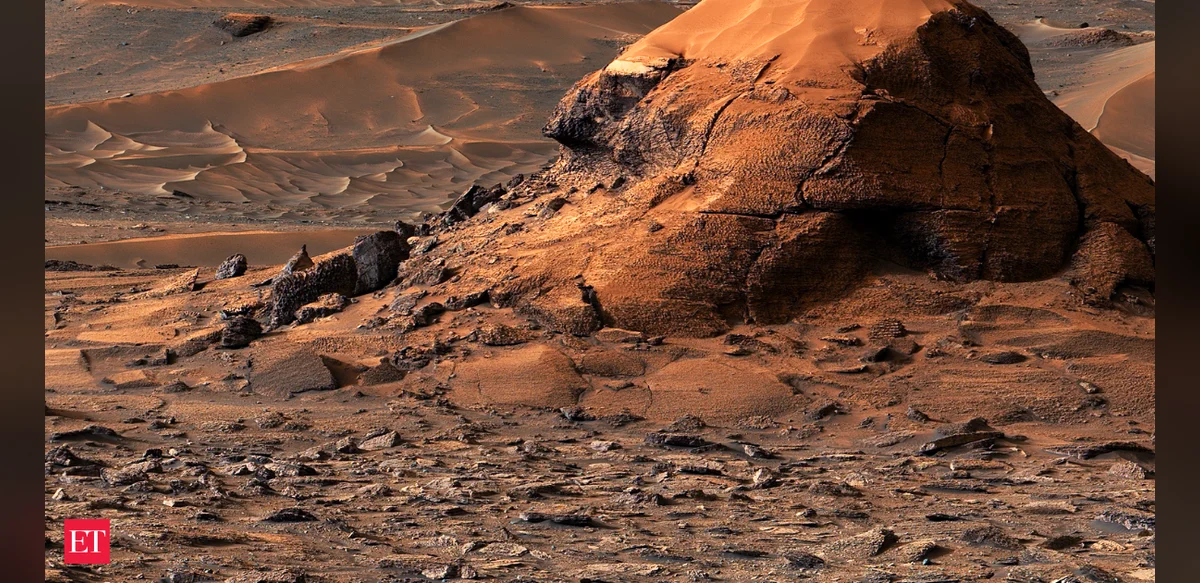
NASA’s Curiosity rover has uncovered evidence that helps scientists understand when Mars transitioned from a planet with flowing rivers and lakes to one dominated by dry dunes. The findings center on hematite crystals discovered in Martian rock samples. These crystals form under specific environmental conditions and can serve as markers for dating major climate changes on the Red Planet.
The rover’s analysis indicates that Mars once hosted liquid water on its surface billions of years ago. Over time, the atmosphere thinned and temperatures dropped, leading to the evaporation of surface water. This shift left behind vast dune fields that now cover much of the planet. Hematite, an iron oxide mineral, preserves details about the timing of this transformation because it forms in the presence of water and then remains stable as conditions become arid.
Curiosity has been exploring Gale Crater, a site chosen for its layered rock formations that record different periods in Martian history. By examining the size, shape, and distribution of hematite crystals, researchers can estimate when water activity declined. The crystals act like a natural clock, recording the moment when the climate became too cold and dry to sustain lakes and rivers.
Scientists note that understanding this timeline is important for assessing whether Mars ever supported microbial life. Liquid water is considered essential for life as known on Earth. If the period of habitability lasted longer than previously thought, the chances increase that simple organisms could have existed. The hematite data may help narrow the window during which such conditions were possible.
The rover continues to collect samples and transmit data to Earth. Each new measurement adds to a growing picture of Mars’ geological and climatic evolution. Future missions may build on these observations by searching for additional mineral evidence or by returning samples for laboratory study.
NASA emphasizes that the work remains ongoing. The current findings represent one piece of a complex puzzle. Additional analysis of other minerals and rock layers will be needed to refine the timeline. The agency plans to use the information to guide exploration strategies for upcoming spacecraft.
Public interest in Mars exploration remains high. Discoveries like the hematite crystals highlight how robotic missions can reveal details about planetary history without human presence. The data also contribute to broader questions about how planets evolve and what conditions allow life to arise.
The study of Mars’ climate shift offers lessons for understanding Earth’s own environmental changes. While the two planets differ greatly today, both experienced periods when liquid water shaped their surfaces. Comparing the records may improve models of atmospheric evolution across the solar system.
Curiosity’s instruments are designed to detect subtle chemical signatures preserved in rock. Hematite stands out because it resists later alteration, making it a reliable indicator of past conditions. The rover’s drill and analysis tools allow scientists to examine material that has been buried for billions of years.
As the mission progresses, researchers expect more insights into the drying of Mars. Each new crystal sample adds precision to the climate timeline. The work underscores the value of long-duration rover operations that can revisit sites and collect diverse data sets.
Overall, the hematite findings reinforce the narrative of a once wetter Mars that gradually lost its surface water. They provide a concrete method for dating that transition and support continued exploration aimed at uncovering the planet’s full history.

