


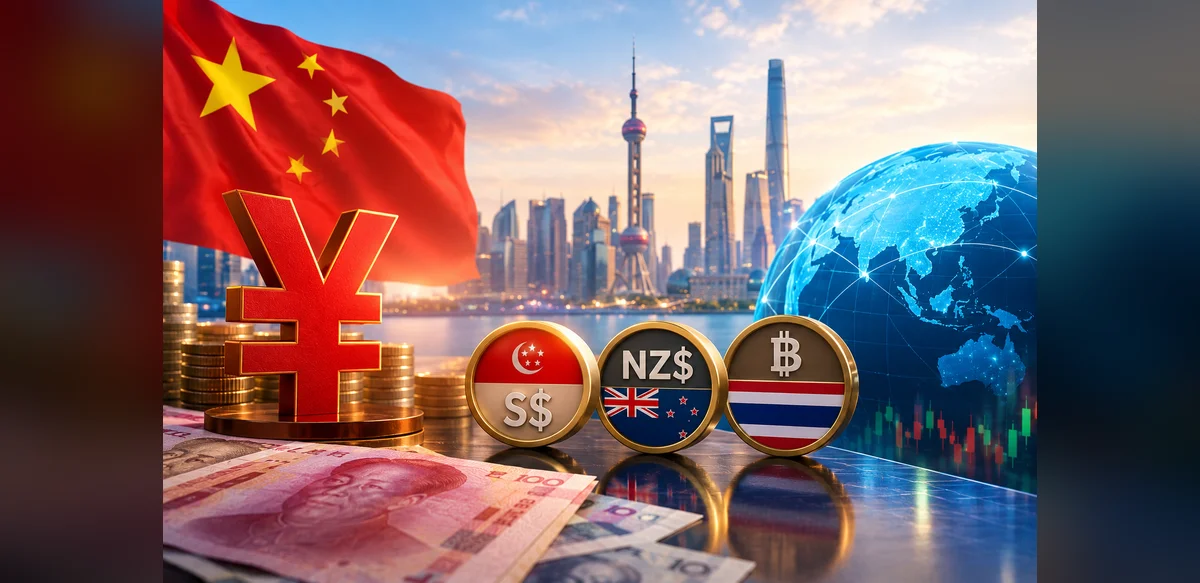
China has taken measures to extend its yuan foreign exchange clearing arrangements by adding the Singapore dollar, New Zealand dollar and Thai baht to the list of supported currencies. This development forms part of a wider initiative by authorities in Beijing to increase the international profile and practical application of the yuan in cross border dealings.
The updated clearing setup is designed to improve the operational backbone for handling yuan transactions. It provides enhanced capacity for processing exchanges and settlements, which in turn can contribute to deeper market liquidity when the yuan is paired with the newly included currencies. Market participants may find it easier to conduct business without relying on intermediate currencies for conversion.
Direct trading and settlement channels are expected to become more accessible for a larger group of overseas counterparts. Financial institutions and corporations engaged in regional trade could benefit from streamlined procedures that reduce complexity and potential costs associated with currency conversion. The changes align with ongoing efforts to embed the yuan more firmly within global payment networks.
Analysts observe that such infrastructure upgrades often precede gradual shifts in how international trade invoices are denominated. While the immediate effects may be modest, the cumulative impact over time could encourage greater acceptance of the yuan in commercial contracts and investment portfolios across Asia and beyond. Regulatory bodies continue to monitor liquidity conditions and settlement volumes to ensure the system remains robust.
The inclusion of these three currencies reflects a targeted approach focused on regional partners with significant trade links to China. Singapore serves as a major financial hub, New Zealand maintains steady commodity based exchanges, and Thailand represents an important ASEAN economy with growing bilateral flows. Each addition supports specific corridors where yuan usage has potential to expand.
Clearing banks involved in the process will need to adjust their operational frameworks to accommodate the new currency pairs. This includes updating risk management protocols and ensuring compliance with relevant international standards for foreign exchange activities. The overall goal remains the creation of a more resilient and versatile platform for yuan related business.
Market observers note that liquidity improvements could manifest in narrower bid ask spreads for the affected currency pairs. Greater depth in these markets may attract additional participants who previously found the yuan less convenient for everyday transactions. Over successive quarters, transaction data will reveal whether the expansion achieves its intended outcomes.
Authorities have emphasized that the initiative is evolutionary rather than revolutionary. It builds upon earlier steps taken to internationalize the yuan, such as establishing clearing arrangements in other financial centers. The current round focuses on practical enhancements that facilitate everyday usage rather than dramatic policy shifts.
Businesses operating across borders may gradually incorporate the yuan into their treasury operations as settlement options improve. Importers and exporters dealing with Chinese counterparts could explore invoicing in yuan to reduce exposure to other currency fluctuations. Such adaptations typically occur incrementally as confidence in the clearing infrastructure grows.
The broader context involves continued dialogue between Chinese regulators and their counterparts in partner countries. Coordination on regulatory recognition and operational standards helps ensure that the expanded clearing network functions smoothly. This collaborative dimension is essential for sustaining momentum in yuan internationalization efforts.
In summary, the recent broadening of yuan foreign exchange clearing represents a measured advancement in China’s strategy to promote wider currency adoption. By incorporating the Singapore dollar, New Zealand dollar and Thai baht, the system gains additional reach and operational efficiency. Market participants will watch subsequent volume trends to assess the practical significance of these adjustments.


