


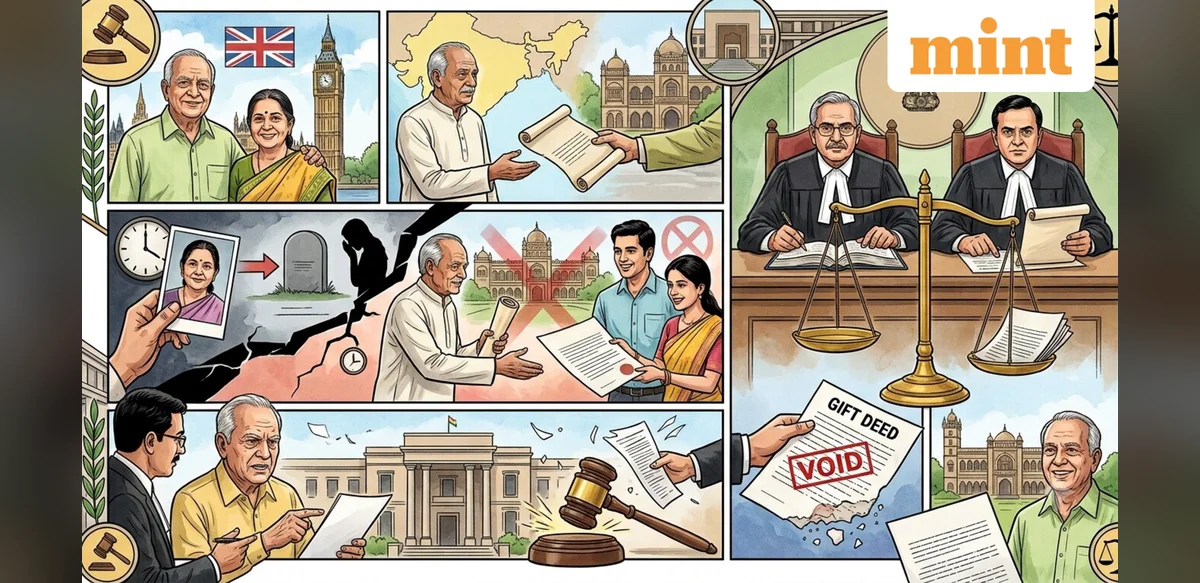
The Gujarat High Court recently addressed a significant dispute involving a power of attorney and the limits of authority granted under such instruments. The case centered on a property located in Vadodara that belonged to a non-resident Indian. A gift deed executed by the attorney holder was challenged and ultimately set aside by the court.
In its ruling the bench observed that the power of attorney in question had automatically terminated upon the death of the property owner’s wife. The document itself did not contain any clause permitting the attorney to transfer ownership as a gift to third parties including his own relatives. Consequently the transfer of the Vadodara asset to the attorney holder’s son and daughter-in-law was declared invalid.
The judgment underscores the principle that a power of attorney is a strictly limited mandate. It grants the holder the ability to perform only those acts that are expressly authorized or that are reasonably necessary to fulfill the stated purpose. Any action exceeding those boundaries lacks legal force and can be challenged successfully in court.
Legal experts note that many property owners execute powers of attorney to manage affairs while living abroad. However the instrument must be drafted with precision. Broad language that appears to allow gifts or sales to family members of the attorney can create disputes later. Courts generally interpret such documents narrowly to protect the interests of the original owner.
In the present matter the court examined the sequence of events leading to the gift deed. It found that the attorney had acted after the principal’s wife passed away an event that ended the agency relationship. The absence of explicit permission to make gifts further weakened the validity of the transfer. The bench therefore directed cancellation of the deed and restoration of the property records to reflect the original ownership.
The decision serves as a reminder for individuals granting powers of attorney to review the scope of authority carefully. It is advisable to specify whether the holder may sell lease or gift the asset and to whom such transfers may be made. Clear termination clauses tied to life events can also prevent unintended continuation of authority.
Property disputes involving non-resident owners often reach Indian courts when local representatives exceed their mandate. The Gujarat High Court ruling adds to the body of case law emphasizing fiduciary duties. An attorney holder must act solely in the interest of the principal and cannot derive personal benefit unless the document expressly allows it.
Advocates recommend periodic review of existing powers of attorney especially when family circumstances change. Death of a spouse or other key events may automatically revoke the instrument under general principles of agency law. Continuing to act after such revocation exposes the holder to legal liability and potential cancellation of transactions.
The Vadodara property case illustrates how courts balance the convenience of powers of attorney against the need to safeguard ownership rights. While these instruments facilitate management of assets from a distance they do not confer unlimited power. Any transfer that appears self-serving or lacks explicit authorization is likely to face judicial scrutiny.
Individuals planning to grant powers of attorney are encouraged to consult legal professionals familiar with property regulations. Drafting should include precise descriptions of permitted acts and explicit restrictions on gifting or transferring to relatives of the attorney. Such precautions reduce the risk of future litigation and ensure that the owner’s intentions are respected.
The Gujarat High Court judgment reinforces established legal standards without introducing new doctrines. It simply applies long-standing rules regarding termination of agency and the limits of authority granted by power of attorney. Property owners and their representatives alike can draw guidance from the outcome when structuring or reviewing similar arrangements.

