

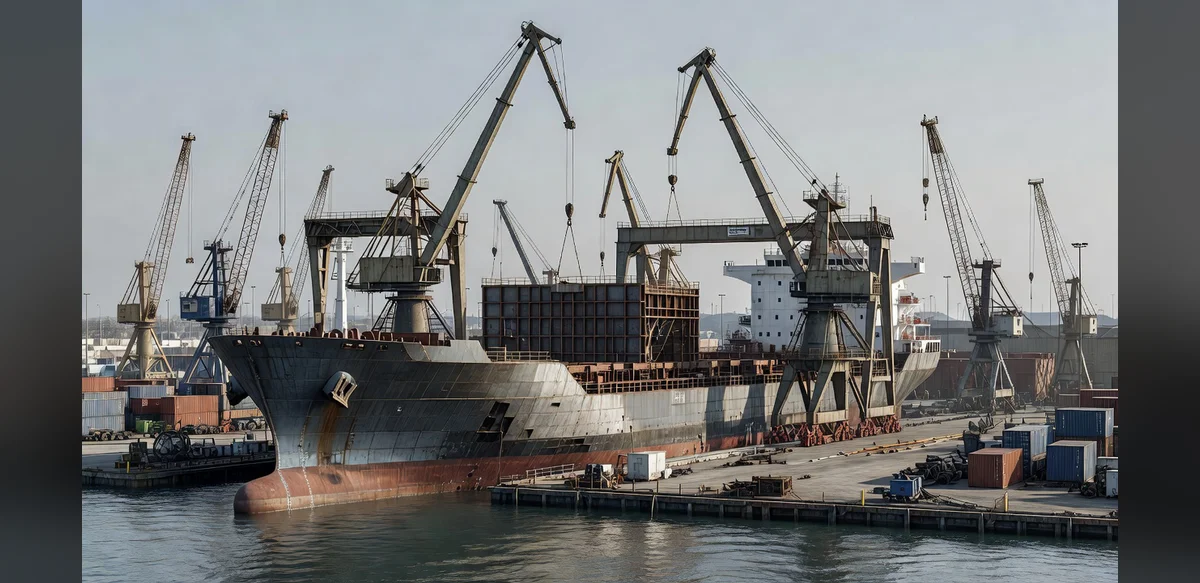
A newly formed joint venture involving Samudera Shipping Line and Imoto Corporation has taken its initial step into vessel construction by placing an order for a feeder ship with a capacity of 696 twenty-foot equivalent units. The agreement was reached with a shipbuilder located in China, with the vessel scheduled for handover during the first half of 2028. This development marks an expansion move for the Kobe-based entity, which was established to support operations in the Japanese market.
The contract signing represents a strategic decision to invest in new tonnage rather than relying solely on existing or second-hand tonnage. Feeder vessels of this size are typically deployed on regional routes where cargo volumes require efficient but modest capacity. Delivery timelines in the shipbuilding sector often span several years due to yard schedules and material availability, which aligns with the stated 2028 timeframe.
Industry observers note that such orders reflect ongoing adjustments in maritime logistics networks. Companies frequently evaluate fleet renewal options to maintain service reliability and meet evolving regulatory standards on emissions and efficiency. The choice of a Chinese shipyard follows common practice in the sector, where competitive pricing and production capacity influence selection.
The joint venture itself was incorporated to facilitate closer engagement with Japanese trade flows. Incorporation occurred prior to the current order, allowing the partners to establish operational foundations before committing to capital expenditure on new assets. Details regarding the exact ownership split or additional planned investments remain limited at this stage.
Market conditions in container shipping continue to influence ordering patterns. After periods of elevated freight rates, some operators have pursued fleet growth while others have adopted more cautious approaches. A 696 TEU feeder falls into a category suited for intra-Asia or short-sea services, where port infrastructure and cargo consolidation patterns favor smaller vessels over larger ones.
Construction of the vessel will take place at Zhejiang Xinle Shipbuilding, a yard that has handled various commercial orders in recent years. The project will involve standard specifications for a modern feeder, including features that support fuel efficiency and compliance with international maritime conventions. Once delivered, the ship is expected to enter service under the joint venture’s management.
Partnerships between established carriers and regional players often aim to combine operational expertise with local market knowledge. In this instance, the collaboration seeks to strengthen presence in Japan while leveraging broader networks for cargo sourcing. The newbuilding order provides a tangible indication of long-term commitment to that strategy.
Further updates on the project are anticipated as construction milestones approach. These may include keel laying, launching, and sea trials, each offering insight into progress toward the 2028 delivery target. Until then, the focus remains on preparatory work and integration of the new asset into existing service patterns.
Overall, the transaction underscores measured fleet development within a specialized segment of the container trade. By securing a purpose-built feeder, the venture positions itself to address specific route requirements without overextending capacity. The coming years will reveal how this investment aligns with broader shifts in regional shipping dynamics.


