


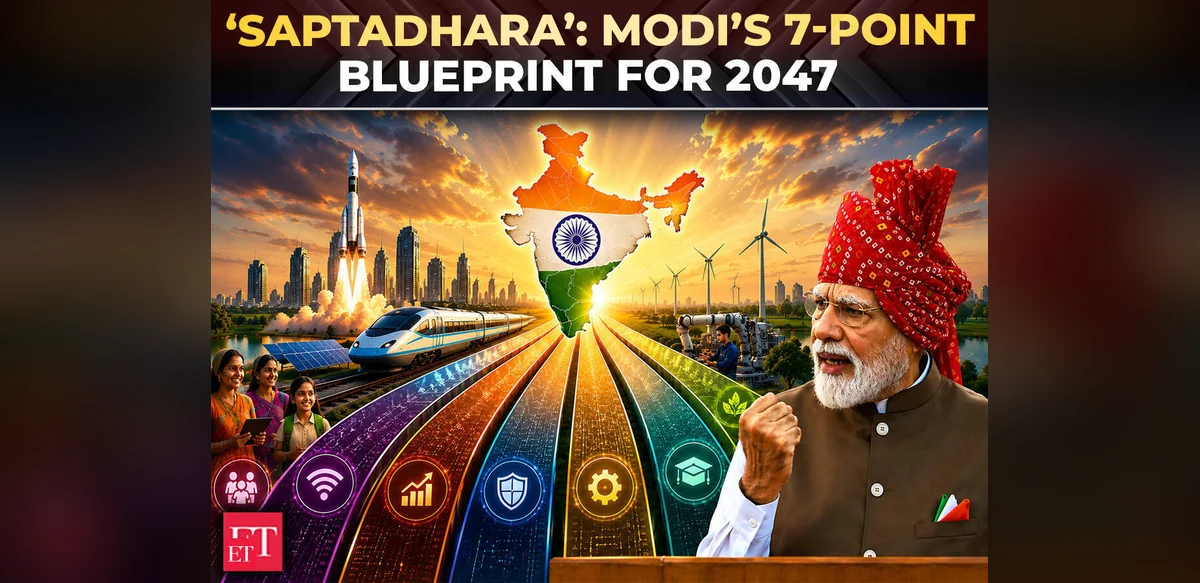
Prime Minister Narendra Modi introduced a comprehensive seven-stream framework called Saptadhara during his address from the Red Fort. This initiative outlines key areas to guide the country toward developed status by the year 2047. The plan focuses on strengthening industrial output, enhancing farm productivity along with related processing industries, advancing technological capabilities and creative solutions, improving multimodal connectivity through infrastructure projects, building independent capabilities in security equipment, and expanding cultural influence globally.
The announcement emphasized coordinated efforts across these domains to support sustained economic expansion. Officials noted that each stream includes targeted measures to address current challenges while preparing for future demands. For instance, the manufacturing component seeks to increase domestic production capacity and integrate more local suppliers into global supply networks. Agriculture and food processing efforts aim to raise yields, reduce post-harvest losses, and create value-added products for both domestic and export markets.
Technology and innovation receive dedicated attention through support for research institutions and startup ecosystems. The connectivity stream builds on existing infrastructure programs to link regions more efficiently, facilitating movement of goods and people. Defence self-reliance involves scaling up indigenous design and production of equipment to reduce import dependence. Additional streams address education quality, skill development, and promotion of Indian heritage and arts on the world stage.
Government statements highlighted that the framework draws from past achievements and lessons to set measurable milestones. Implementation will involve collaboration between central ministries, state administrations, and private sector participants. Regular reviews are planned to track progress and adjust strategies as needed.
Analysts observed that the approach integrates economic, technological, and social elements to create balanced growth. The emphasis on self-reliance in critical sectors is expected to enhance resilience against external disruptions. At the same time, openness to international partnerships in trade and innovation remains a core principle.
Public response has been mixed, with some welcoming the structured roadmap while others call for more details on funding and timelines. The Prime Minister urged citizens to contribute through individual and community actions aligned with national goals. Events and campaigns are being organized to spread awareness about the seven streams and encourage participation.
Over the coming months, detailed policy documents and budget allocations for each area are anticipated. State-level adaptations of the framework will also be developed to account for regional variations in resources and priorities. International observers are monitoring the initiative for its potential impact on global economic dynamics.
The Saptadhara plan represents an effort to align short-term actions with a long-term vision. By focusing on multiple interconnected streams, the government seeks to address diverse aspects of national development simultaneously. Success will depend on consistent execution, stakeholder engagement, and adaptability to changing circumstances.
Further updates on specific projects under each stream are expected in subsequent official communications. The overall objective remains to position the country as a leading economy with strong foundations in industry, agriculture, technology, infrastructure, security, and cultural outreach.

