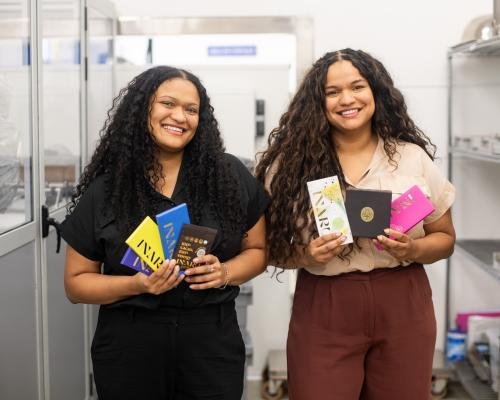
Janett and Erika Liriano were raised in Queens, New York, by parents who emigrated from the Dominican Republic and encouraged ambitious goals. Their efforts led to notable achievements: by their late 20s, Janett earned a spot on the Forbes 30 Under 30 list and served as chief of staff at a biopharmaceutical company, while Erika built a career in venture capital. Despite these accomplishments, both felt dissatisfied with their roles. ‘We had stability but lacked fulfillment in our work,’ Janett explained. ‘I was eager for a new direction but uncertain about the path.’ In early 2019, during a family gathering at Janett’s home in Kew Gardens, they sampled a beverage made from Dominican cacao and coffee prepared by their father. This sparked discussions about launching a chocolate enterprise in the Dominican Republic, though Janett initially dismissed the idea due to her demanding job. Their parents urged them to pursue personal ventures, noting, ‘If you dedicate the same effort to your own ideas as you do for others, you could make a significant impact in the country.’ The sisters had often heard stories of their parents’ challenging upbringing in the Dominican Republic. Their mother’s parents labored as farm workers, and their father’s relatives operated a modest cocoa plantation. Their parents emphasized that the nation faced issues not from poverty alone, but from insufficient value creation that could benefit all citizens, according to Janett. The Dominican Republic supplies around 60% of global organic cacao, yet most exports consist of unprocessed beans. Consequently, the bulk of the $8 billion in profits from this commodity accrues to processing nations such as Belgium, Germany, and the United States, leaving many local farmers in financial hardship. Janett and Erika believed their professional skills could transform the sector, but they hesitated about operating in the Dominican Republic. ‘We lacked business knowledge about the area,’ Janett noted. Quitting secure positions also posed risks. ‘I had a good income and savings,’ Erika recalled. ‘Was I prepared to relocate and rely on chance?’ Their parents pointed out their own bold move to the United States and volunteered to accompany the sisters. This decision marked a major shift amid the pandemic, as Janett described it. In 2020, the siblings resigned from their jobs and, along with their parents, relocated to the Dominican Republic. They traveled extensively, staying in short-term rentals, to immerse themselves in the cacao trade. ‘We spent months trailing our father, riding in truck beds, to grasp the supply chain dynamics,’ Janett said. They learned that producers often sold to the earliest arriving buyer with a vehicle, who frequently exploited them through low offers, late payments, or inaccurate measurements. This practice is widespread in the field, not limited to the Dominican Republic, according to Antonie Fountain, managing director of the Voice Network, an alliance of nongovernmental organizations and labor groups. ‘Farmers are essentially price recipients,’ he stated. In a market prone to fluctuations from weather events, ‘they receive whatever the global rate dictates, unless connected to a committed purchaser.’ The Liriano family resolved to become that reliable partner. Following extensive consultations with growers, industry research, and collaboration with a designer for branding, the sisters introduced Inaru Chocolate. The name, derived from a Taino term for fertility or creation, positions the firm as the nation’s inaugural fully integrated cacao operation. Instead of relying on informal transporters, it establishes direct agreements with farmers and compensates agents at a set fee, removing motivations to shortchange producers, Janett explained. The business allocates 3% of each product’s revenue to farmers, resulting in payments 30% to 50% above typical local rates, she added. This enables investments in land and methods that improve environmental outcomes and bean quality, ultimately boosting earnings. ‘Inaru treats farmers as true collaborators in the enterprise’s achievements, rather than remote vendors,’ said Jennifer Gomez, chief marketing officer at the Founder’s Pool, which backs the company. ‘They have transformed a disjointed network into a clear, family-oriented system.’ The siblings recognized that substantial gains for themselves and the farmers would arise from manufacturing premium chocolate within the country: a metric ton of raw beans might sell for $30,000 internationally, but the same amount of completed chocolate commands a higher value.