


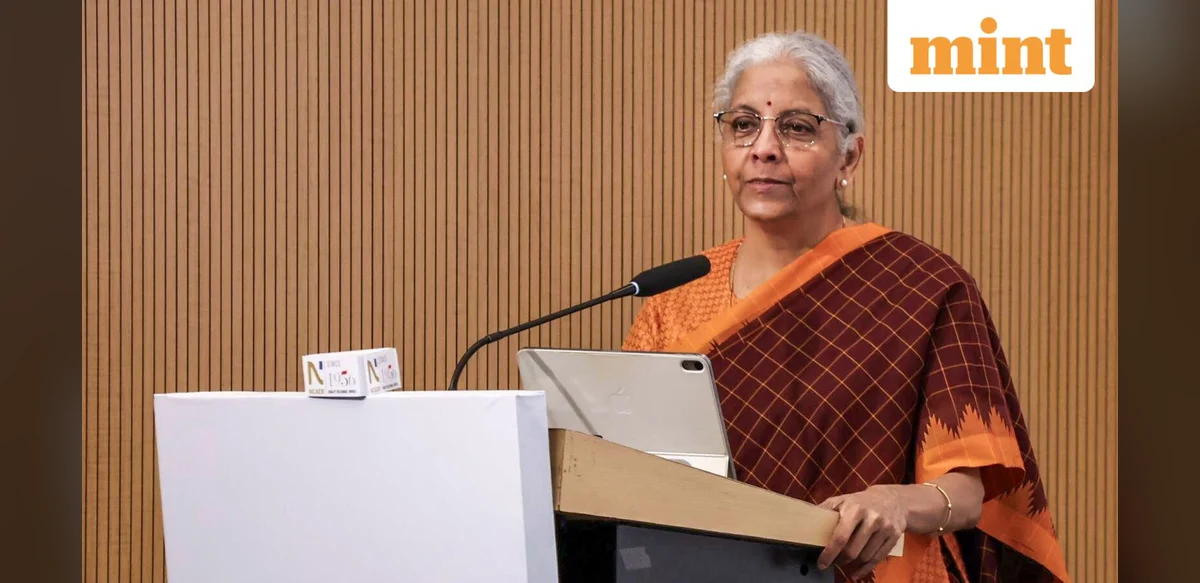
New Delhi: Finance minister Nirmala Sitharaman on Thursday described the government plan for Viksit Bharat as a developed economy marked by zero poverty, universal quality education, affordable healthcare for all citizens and skills plus employment for every young person.
She stressed the importance of full economic participation by women and farmers turning India into a global food supplier while speaking at the C.D. Deshmukh Memorial Lecture during the 23rd India Policy Forum hosted by the National Council of Applied Economic Research.
The minister called for cooperation across generations, noting that India’s future rests on blending the experience of older citizens with the energy and fresh ideas of younger ones who will define the nation in 2047 and later.
She said the older generation holds the nation’s wisdom and memory while the younger one supplies the drive, creativity and leadership needed to carry out the next stage, as they will inhabit 2047 and beyond.
Looking back at India’s path since independence, Sitharaman noted the country faced partition, mass poverty, food shortages and a limited industrial base, followed by wars, droughts and reliance on outside support that pressured public finances in the early years.
She criticised the old centralised planning approach and licence-quota-permit system, arguing that heavy concentration of power, discretionary rules and state-directed investment held back enterprise, encouraged inefficiency and corruption and slowed growth.
At the same time she noted that those decades produced key institutions such as Isro, Barc, BHEL and the IITs along with major irrigation and power projects that prepared the ground for later progress.
She described the turn of the century as a key shift when economic growth, physical links and digital systems became central priorities. The 2008 global crisis tested economies but India’s household savings and tightly regulated banks provided a buffer, though later years brought larger fiscal gaps, higher subsidies, ongoing inflation and twin deficits.
Since 2014 reforms have centred on financial inclusion through the JAM trinity, inflation control via the monetary policy committee, recognition of bad loans, the Insolvency and Bankruptcy Code, digital public systems, goods and services tax and spending on science, technology and higher education.
Despite repeated global shocks India has continued to cut multidimensional poverty and move its development goals forward, she said.
India stays among the fastest-growing major economies. The IMF projects 6.4 percent growth in 2026 even amid a softer global outlook, highlighting the task of keeping rapid expansion while creating quality jobs and building human capital.
For the coming decades Sitharaman said India must drop any sense of victimhood and ensure financial bodies, governance systems and public resources open chances based on merit rather than connections. Banks must stay tools of inclusion and programmes such as the Pradhan Mantri Mudra Yojana have helped ordinary people start businesses.
Earlier the same day NCAER chairman Nandan Nilekani set out a plan for continued fast growth, saying India should foster more than one million startups by 2035, ease rules for small firms and adjust social security for a mobile workforce while generating enough jobs for its young population.
He argued the demographic dividend will materialise only if high growth continues together with large-scale job creation.
Above all India must become a nation of entrepreneurs, Nilekani said, pointing out that technology startups rose from under 10,000 a decade ago to about 150,000 today and could exceed one million by 2035 if current trends hold.
Future jobs will increasingly come from millions of small businesses rather than a few large companies, he added, while artificial intelligence is expected to automate many tasks.

