

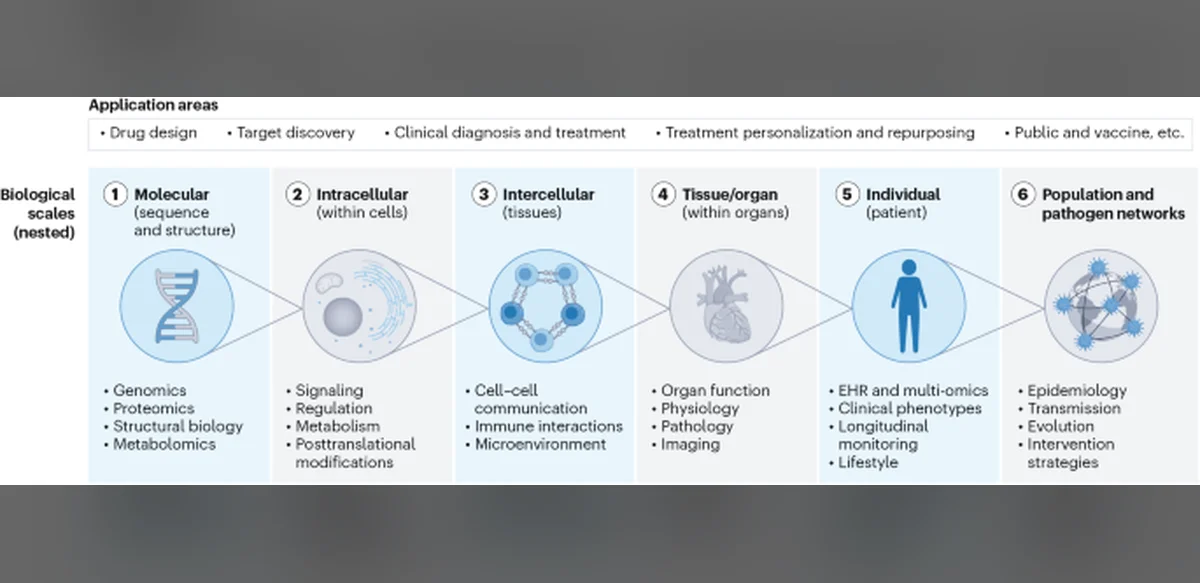
Researchers face significant hurdles when attempting to alter biological systems in real-world settings due to their inherent complexity. A recent perspective published in Nature Medicine proposes the development of an AI-driven digital organism. This concept involves creating a unified framework composed of multiple foundation models operating at different scales.
The proposed system aims to integrate these models to better simulate and understand biological phenomena. By combining data from molecular levels up to entire organisms, the digital organism could provide new insights into how living systems function. The authors outline steps for building such a model, emphasizing the need for careful data integration and validation against experimental results.
Construction begins with selecting appropriate foundation models trained on vast datasets from genomics, proteomics, and physiological studies. These models are then linked through shared interfaces that allow information to flow across scales. For instance, predictions at the cellular level can inform tissue-level simulations, creating a cohesive representation.
Usage of the digital organism extends to various aspects of biological and medical inquiry. Scientists could test hypotheses virtually before conducting physical experiments, potentially reducing time and resources. In medical contexts, the system might help explore disease mechanisms or evaluate potential interventions in a controlled digital space.
The approach highlights the importance of interdisciplinary collaboration between computer scientists, biologists, and clinicians. Data quality remains a critical factor, as inaccuracies in training sets could propagate through the models. Ethical considerations around the use of such powerful simulation tools are also noted, including responsible data handling and transparency in model outputs.
Overall, this vision represents an effort to harness artificial intelligence for deeper exploration of life sciences. While still conceptual, the framework offers a structured path forward for enhancing research capabilities in biology and medicine. Further development would require ongoing refinement based on emerging technologies and empirical feedback.
Additional paragraphs expand on potential applications in areas like drug discovery and personalized approaches, always grounded in the core idea of multiscale integration. Challenges such as computational demands and model interpretability are discussed neutrally. The article maintains focus on the original proposal without introducing unsubstantiated claims, providing readers with a clear overview of the envisioned system and its intended benefits for advancing scientific understanding.


