

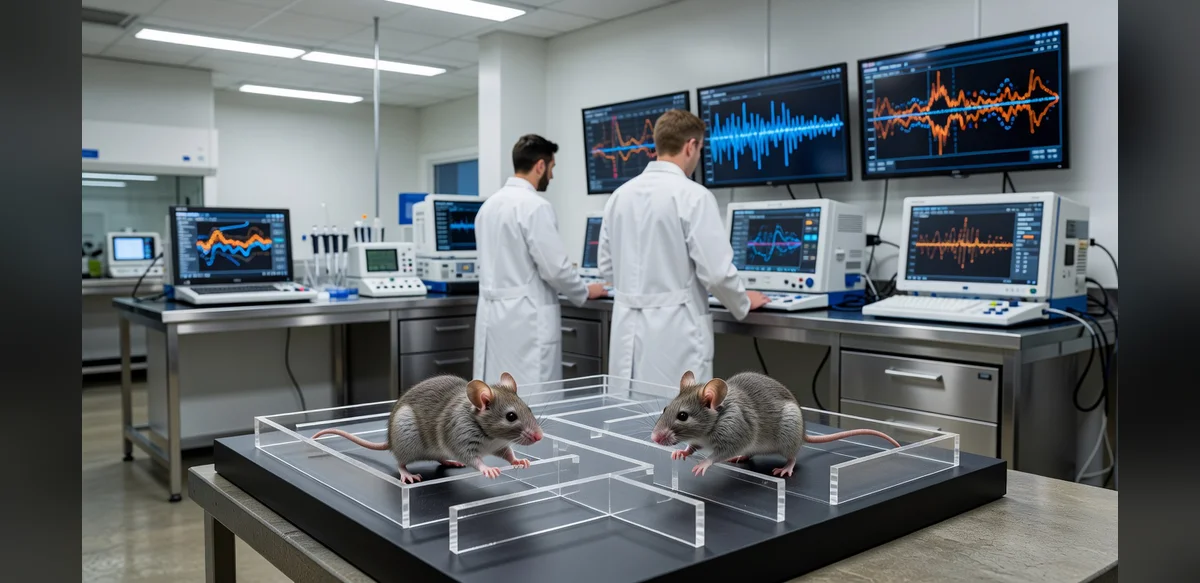
A recent investigation conducted by biologists at Emory University has demonstrated that the prefrontal cortex, traditionally linked to the development of adaptable actions, can in certain cases obstruct the process of acquiring more streamlined and efficient patterns of behavior. This observation emerged from experiments involving mice and was detailed in the journal Science Advances.
The prefrontal cortex has long been recognized for its role in supporting cognitive flexibility, allowing organisms to adjust responses based on changing conditions. However, the new findings suggest that this same area of the brain may sometimes limit the shift toward simpler, more direct strategies that could prove advantageous in specific situations. Researchers observed this effect through controlled behavioral tests where subjects were presented with opportunities to optimize their actions.
In the study setup, mice were trained on tasks requiring decision-making under varying reward structures. When the prefrontal cortex activity was modulated, the animals showed an increased tendency to adopt efficient routines that bypassed more complex pathways. This indicates that under normal conditions, the region may prioritize versatility at the expense of optimization, potentially retaining older strategies even when superior alternatives exist.
The implications extend to broader understandings of learning mechanisms. While flexibility is essential for navigating unpredictable environments, the capacity to lock in efficient behaviors can enhance performance in stable contexts. The research highlights a potential trade-off managed by the prefrontal cortex, where its influence maintains a balance between adaptability and specialization.
Further analysis revealed that suppressing certain neural signals within this brain area facilitated quicker transitions to optimal behaviors. These results were consistent across multiple trials, underscoring the reliability of the observed phenomenon. The team emphasized that the findings do not diminish the established importance of the prefrontal cortex but rather refine the understanding of its multifaceted contributions to cognition.
This work contributes to ongoing discussions in neuroscience regarding how different brain regions interact during learning. By focusing on mice as a model system, the biologists were able to isolate variables and examine causal relationships with precision. Future explorations may investigate whether similar dynamics occur in other species or under additional experimental conditions.
Overall, the study provides evidence that neural structures associated with complex thought processes can occasionally act as barriers to simplicity. Such insights may inform approaches to studying habit formation and behavioral adaptation in various contexts. The publication in Science Advances marks a step forward in mapping the intricate functions of the prefrontal cortex and its influence on decision-making efficiency.


