


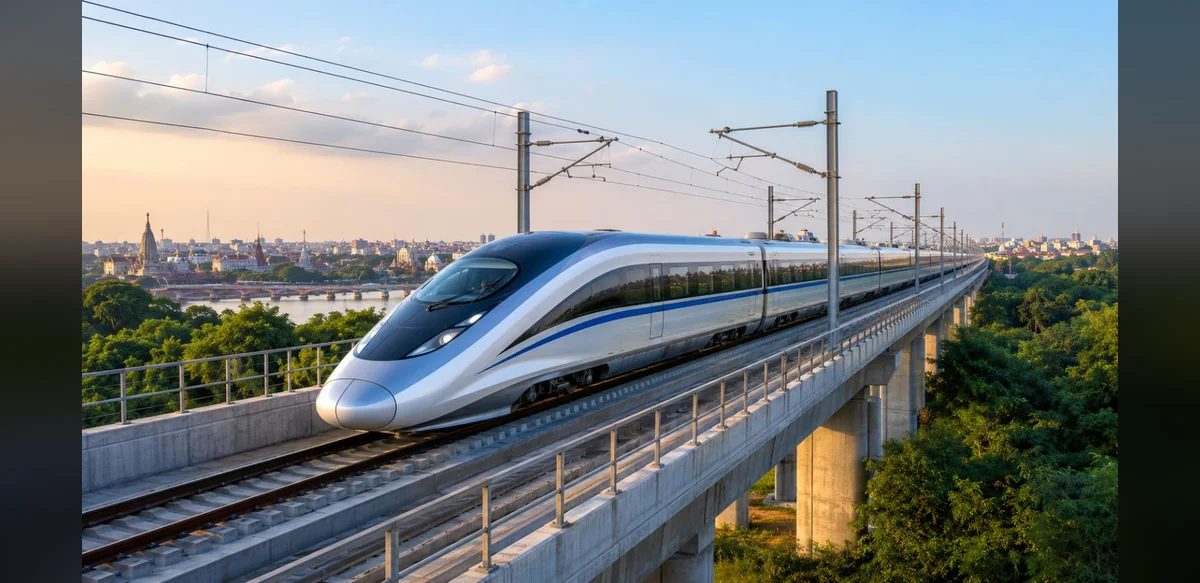
The National High Speed Rail Corporation Limited has called for bids to create civil structure designs for the planned Bengaluru-Chennai and Delhi-Varanasi high-speed rail lines. These routes form part of seven corridors announced in the Union Budget 2026-27 for the next stage of rapid rail development. The other routes include Mumbai-Pune, Pune-Hyderabad, Hyderabad-Bengaluru, Hyderabad-Chennai and Varanasi-Siliguri.
NHSRCL stated that detailed project reports for four of the seven corridors have received approval, while field surveys continue on the remaining three. Alignment checks and preliminary geotechnical studies are also advancing. The seven corridors together cover about 4,000 route kilometres. The agency plans to apply proven design and construction methods from the Mumbai-Ahmedabad corridor, with further refinements, and will standardise designs for various structures.
The Bengaluru-Chennai line is projected to cut travel time to one hour and thirteen minutes. Its bid documents specify three underground stations at Chennai, Whitefield and Baiyappanahalli. Chennai and Baiyappanahalli will each have two platforms and six tracks, while Whitefield will feature two side platforms, one island platform and two tracks. The consultant must also design three major tunnels, including a 3.87 km approach tunnel near Chennai Terminal, a 14.79 km mountain tunnel through the Kaundinya Wildlife Sanctuary and a 15.92 km approach tunnel near Bengaluru Terminal.
The Delhi-Varanasi line is expected to reduce journey time to three hours and fifty minutes. It will include one underground station at Jewar with two island platforms and four tracks. The selected firm will prepare specifications and structural designs for underground stations, shafts, cut-and-cover sections, tunnels and earthworks. All designs must support safe, reliable double-track operations at up to 320 kmph, with a design speed of 350 kmph, while accounting for local environmental and ground conditions.

