


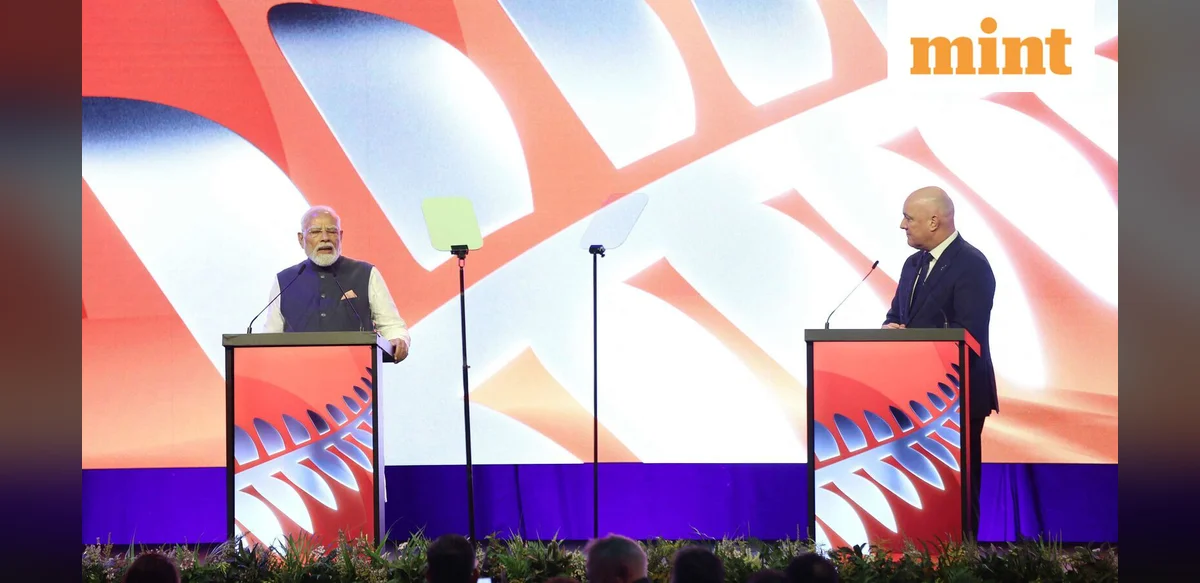
India and New Zealand have decided to work toward doubling bilateral trade in goods and services to NZ$7 billion, roughly ₹35,000 crore, by 2030. The agreement came during talks between Prime Minister Narendra Modi and New Zealand Prime Minister Christopher Luxon, who noted growing momentum in economic relations.
Modi’s arrival in New Zealand marked the first visit by an Indian prime minister to Auckland in four decades. The leaders held delegation-level discussions and urged businesses to strengthen links, identify new prospects, and use the complementary strengths of both economies.
In a joint statement, the Ministry of External Affairs said the two sides adopted an ambitious vision for a Strategic Partnership. This framework seeks to elevate bilateral ties, reinforce existing mechanisms, and identify fresh areas for cooperation at both bilateral and multilateral levels.
Citing shared democratic values, longstanding friendship, and common interests in the Indo-Pacific, the leaders upgraded relations to a Strategic Partnership and approved the India-New Zealand Strategic Partnership: Roadmap to 2030. The document will guide cooperation for the next four years.
The two sides agreed to maintain regular high-level visits and meetings, including at multilateral forums. They also decided to establish a Foreign Ministers’ Dialogue to review progress under the roadmap and to promote parliamentary exchanges.
On defence and security, the leaders committed to stronger law-enforcement cooperation against transnational crime and to finalize arrangements on counter-narcotics. They also launched an annual Maritime Security Dialogue and signed a Maritime Cooperation Arrangement, an agreement on hydrography, and a Mutual Logistics Support Arrangement.
In trade and economic matters, the leaders welcomed the conclusion of a Free Trade Agreement. They noted New Zealand’s potential contribution to India’s goal of becoming a developed nation by 2047 through collaboration in agriculture, skills, innovation, clean energy, and tourism. A tourism memorandum was signed to encourage direct flights between the two countries.

