

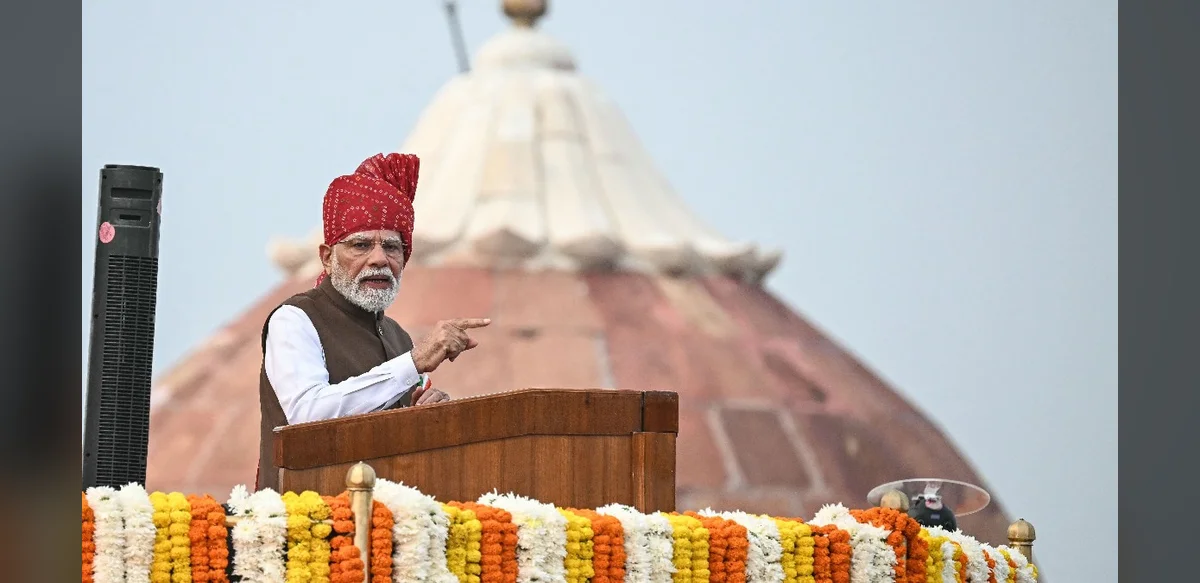
Prime Minister Narendra Modi’s Independence Day address on Saturday centered on the goals of Generation Z and the role of young people in national development. The speech followed recent student demonstrations over examination paper leaks. Modi presented a seven-point reform plan called Saptdhara and cautioned against what he termed intellectual Naxalism. He spoke from the Red Fort about both prospects and difficulties as India advances toward developed status by 2047.
This marked Modi’s 13th consecutive Independence Day address, making him only the second prime minister after Jawaharlal Nehru to reach that number. He renewed emphasis on self-reliance, naming semiconductors, essential minerals and energy security as priorities.
A key political point concerned greater participation by women in decision-making. Modi called on opposition parties to support 33 percent reservation for women in Parliament and state assemblies.
Key points from the address included outreach to young voters through training one crore people in artificial intelligence and free online coaching for competitive exams, aimed at reducing costs for lower- and middle-income households. Modi stated that young people would guide the country to developed status.
He also introduced the Saptdhara framework, modeled on the ancient concept of seven rivers, covering manufacturing strength, agriculture and food exports, technology and innovation including artificial intelligence and space, infrastructure connectivity, defense self-reliance, energy security with plans for five new nuclear reactors, and promotion of cultural soft power.
Modi warned of ideological Naxals present in positions of influence who must be identified and isolated. He appealed for cross-party agreement on the women’s reservation measure, urging leaders to prioritize rights for women regardless of political credit.


