

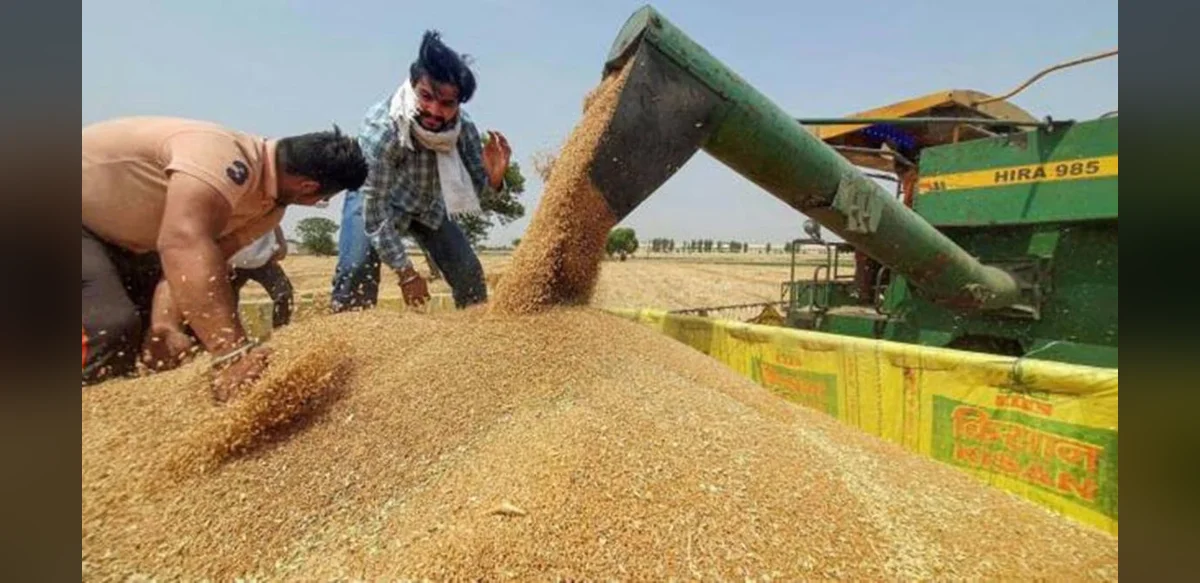
The slow rate of wheat purchasing in Madhya Pradesh, a key supplier to the government’s central reserve used for distributing grains under the 2013 National Food Security Act, has led to a notable decline in the country’s overall procurement during the current rabi season compared to the previous year.
Union Agriculture Minister Shivraj Singh Chouhan highlighted difficulties encountered by farmers in his home state. On Tuesday, he led a virtual meeting to assess wheat buying activities in his Vidisha parliamentary area, covering the districts of Vidisha, Raisen, Sehore, and Dewas.
In the session, Chouhan instructed officials to promptly tackle and fix farmers’ issues through better collaboration.
Food Ministry data indicates that 11.429 million metric tonnes of wheat have been acquired from 10 primary states by April 20, representing 38 percent of the 30.3 million metric tonne goal for this year and a 16 percent drop from the 13.5 million metric tonnes obtained in the same timeframe last year.
Punjab, Madhya Pradesh, and Haryana are the top providers to the central reserve, contributing 11.919 million, 7.774 million, and 7.143 million metric tonnes respectively last year. Procurement started on April 1 in Punjab and Haryana, and on March 15 in Madhya Pradesh. This season, Punjab and Haryana have maintained strong progress, securing 91 percent and 70 percent of arrivals at centers.
In contrast, Madhya Pradesh has shown slower advancement. By April 20, the state recorded 0.725 million metric tonnes purchased from 1.566 million metric tonnes arrived, an 85 percent reduction from the 4.7 million metric tonnes bought in the equivalent period last year.
This lag in Madhya Pradesh is noteworthy due to its role in national food supplies.
Chouhan further ordered priority fixes for problems with booking slots, registrations, and verifications.
Procurement has also been sluggish in Uttar Pradesh, the largest wheat producer nationwide. Despite its output, the state’s input to the central reserve has historically been minimal. Last year, only 1.027 million metric tonnes were acquired from Uttar Pradesh. This year, 0.274 million metric tonnes have been reported by April 20, a 40 percent decrease from the 0.454 million metric tonnes last year. Operations in Uttar Pradesh began on March 17.
Sources suggest that the slow pace in Uttar Pradesh will be addressed in a meeting between state Food and Civil Supply Minister Satish Chandra Sharma and Union Food Minister Pralhad Joshi on Wednesday.
Sharma attributed the delays to unexpected rains in late March and early April across the state.
Wheat cultivation area for the 2026 rabi season rose to 33.417 million hectares from 32.804 million hectares the prior year.
The second advance estimate projects wheat output at 120 million metric tonnes for 2025-26, an increase from 117 million metric tonnes in 2024-25.
Buffer stock rules require 7.46 million metric tonnes of wheat on April 1 annually, rising to 27.5 million metric tonnes by July 1.
In February, the government permitted exports of 2.5 million metric tonnes of wheat, followed by an additional 2.5 million metric tonnes earlier this month.


