


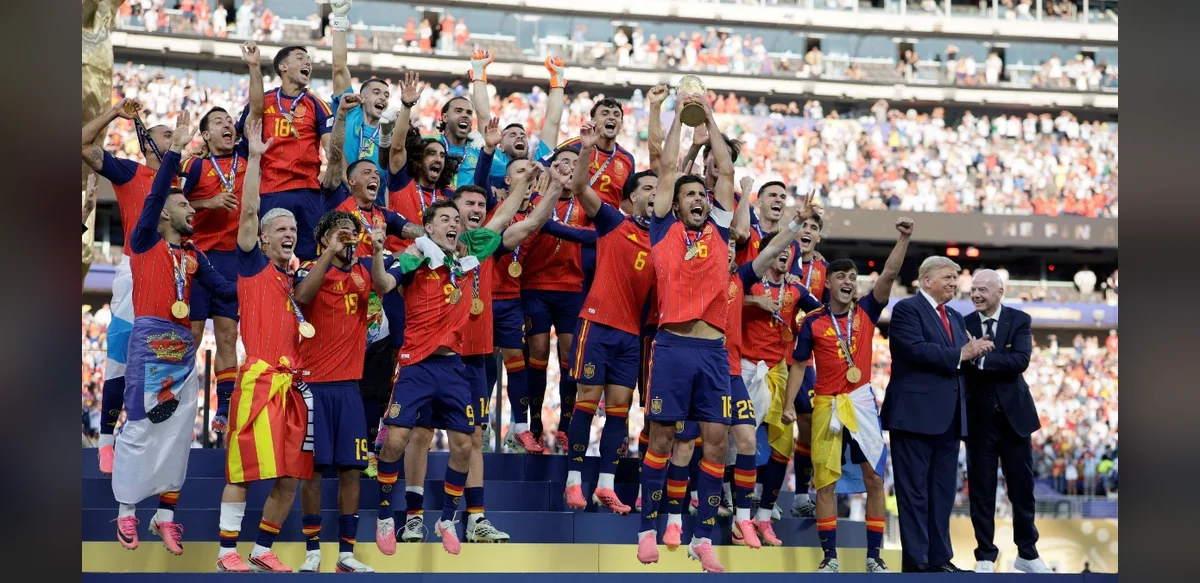
Lionel Messi entered the match in New Jersey seeking to close his international career with another major honor after already securing football’s top prize. Instead, Spain authored the outcome from start to finish.
Luis de la Fuente’s team did more than narrowly defeat the title holders. They controlled the contest throughout. Spain held most of the ball, set the pace and prevented Argentina from building attacks until Ferran Torres scored in extra time to seal a 1-0 win and Spain’s second World Cup crown.
The result understated Spain’s dominance. Argentina recorded no shots in the first 70 minutes, the longest such stretch in a World Cup final since 1966. Messi touched the ball only 22 times in that span as Spain’s midfield blocked the passes that usually created chances for the player.
Spain still needed patience. Emiliano Martinez made several strong saves, Mikel Merino headed wide from close range and two Spanish goals were disallowed. By the end of regular time Spain held an expected goals value near 1.0 while Argentina had not tested the opposing goalkeeper.
The decisive goal came 37 seconds into the second period of extra time. Pedro Porro delivered a high cross that Nico Williams headed back across the goal. Torres ran onto the ball and struck a left-footed shot into the net for his first goal of the tournament.
Argentina pushed forward late but Spain stayed organized. Messi sent one cross near the goal and another effort was blocked, yet the defending champions never created enough pressure to reach penalties.
At the final whistle Spain stood as deserved champions after dominating the match for nearly two hours.
Messi received close attention throughout. Spain ensured every touch occurred under pressure. When he moved into central areas midfielders were positioned to intercept. When he shifted wide additional defenders closed quickly. The approach focused less on marking Messi individually and more on limiting service to him in threatening zones.
By the 70th minute Messi had only 22 touches and Argentina still lacked a shot. Spain achieved this by maintaining possession and movement that forced Argentina to shift side to side until openings appeared.
Spain’s wingers created different threats. One sought the ball at his feet to beat defenders directly while the other exploited space behind the defense. At halftime Spain had taken all three shots and held an expected goals value of 0.23. Argentina had only clearances and running to show.
Spain’s younger players showed no hesitation despite the occasion. They performed with the assurance of a team that expected victory before the scoreline confirmed it.
Martinez kept his side in contention with multiple saves that denied promising Spanish moves. The goalkeeper nearly extended Argentina’s stay in the competition.

