

New Delhi. An Allahabad High Court ruling has renewed debate over the balance between religious expression and institutional dress codes in Indian schools. The case involved a Class XI student at a private school in Prayagraj who challenged a prohibition on wearing the hijab on campus. In its August decision a two-judge bench examined the petition under Article 25 of the Constitution, which guarantees freedom of conscience and the right to profess, practise and propagate religion. The court emphasised that this protection is not unlimited and remains subject to considerations of public order, morality, health and institutional discipline.
The bench applied the doctrine of essential religious practices and concluded that wearing the hijab is not an indispensable element of Islam. Without it, the court stated, the religion would continue to exist. Consequently the judges held that a school uniform prescribed by the institution takes precedence in maintaining discipline and equality among students. No pupil, regardless of gender, possesses a legal right to exemption based solely on personal or religious preference.
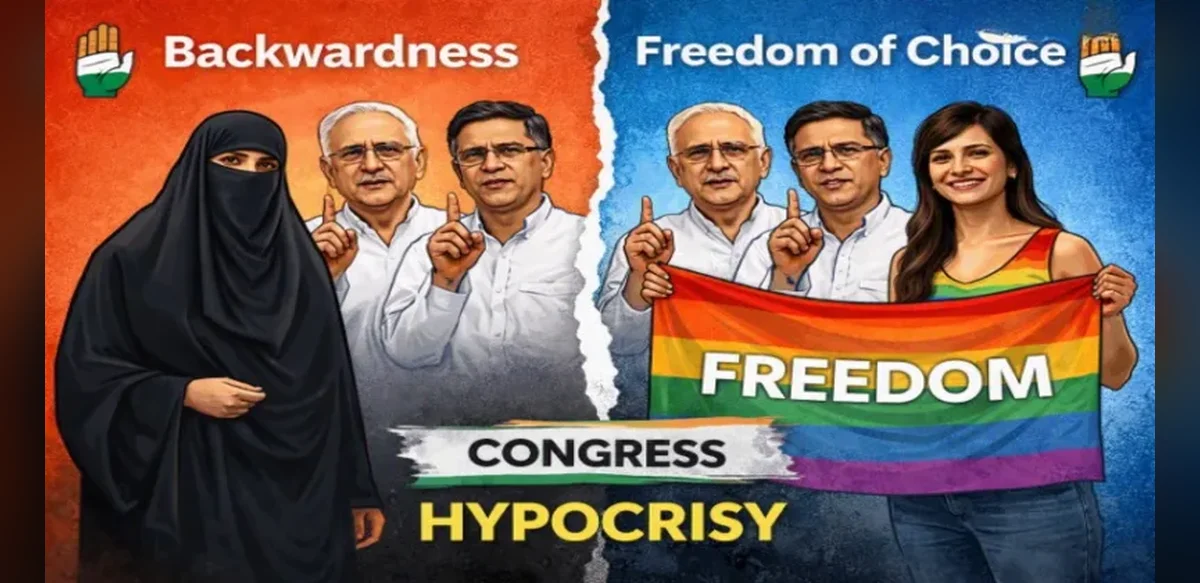
The verdict triggered immediate political reactions across the country. The Indian National Congress criticised the judgment and expressed support for the student’s claim to wear the hijab. Party spokespersons argued that questions of religious observance should be left to scholars rather than judicial determination. They framed the issue as one of personal choice and bodily autonomy for women.
Observers noted an apparent shift in the party’s earlier position. In 2019 the Congress-led government in Rajasthan had launched the Ghoonghat Hatao Abhiyan through the Department of Women and Child Development. That campaign described veiling practices as obstacles to women’s empowerment and encouraged their abandonment in favour of broader social participation. Critics of the current stance highlighted the contrast between the 2019 description of veiling as regressive and the 2026 portrayal of similar attire as an expression of individual agency.
Congress leaders, including media department head Pawan Khera, issued statements on social media rejecting the court’s authority to define religious essentials. They reiterated the party’s commitment to women’s autonomy while opposing the uniform requirement. The Bharatiya Janata Party responded by accusing the opposition of inconsistent standards driven by electoral considerations.
Legal experts have pointed out that similar disputes have arisen in other states and that high-court rulings on essential practices often reach the Supreme Court for final clarification. Educational institutions continue to stress the importance of uniform policies in fostering an environment free from visible distinctions that could affect classroom cohesion.
Public discussion has extended to broader questions of secularism in schools, the limits of religious accommodation and the role of political parties in framing judicial outcomes. Analysts suggest the episode illustrates ongoing tensions between individual rights and collective institutional norms within India’s diverse society. The case remains part of a larger conversation about how constitutional provisions are interpreted in everyday settings such as classrooms.
Further hearings and possible appeals may provide additional guidance on the scope of Article 25 in educational contexts. Meanwhile schools across Uttar Pradesh and other regions are reviewing their dress-code policies in light of the Allahabad decision. Parents and students await clarity on how the ruling will be applied in practice during the upcoming academic session.


