


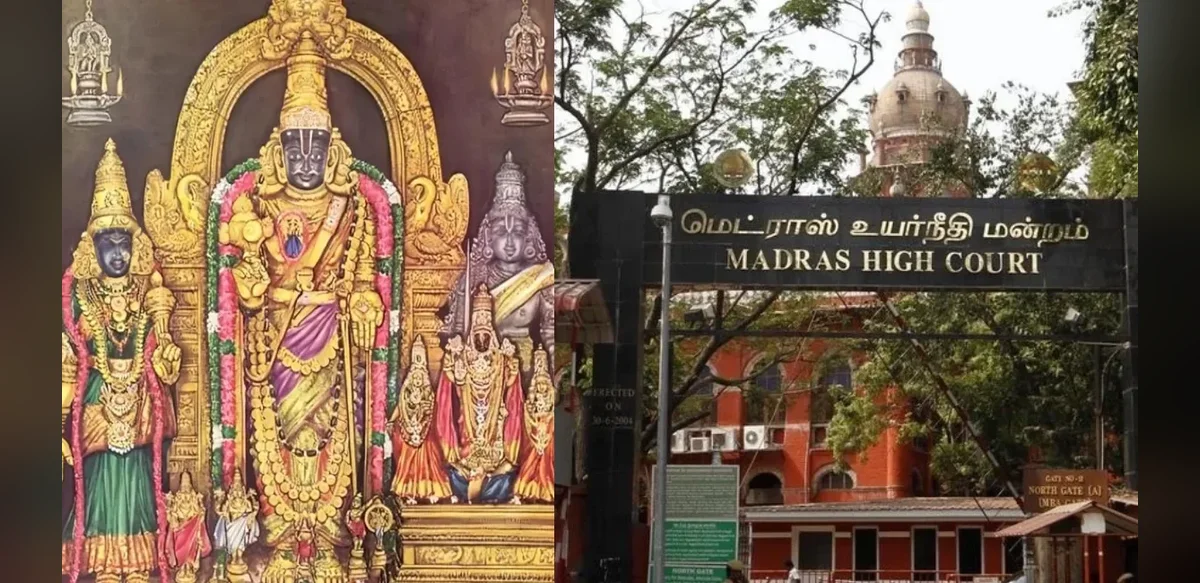
The Madras High Court has ruled that executive officers appointed by the Hindu Religious and Charitable Endowments department lack authority to intervene in the religious activities, customary practices, and traditions observed at temples. Instead, the responsibility for temple management must remain with the board of trustees. This decision came from a division bench comprising Justices G.R. Swaminathan and V. Lakshminarayanan on May 29, 2026, in response to a petition filed by temple activist T.R. Ramesh. The case involved the state government, the department commissioner, and the fit person or executive officer at the Sri Parthasarathy Swamy Temple in Triplicane.
The activist welcomed the outcome and shared comments on social media, emphasizing that the ruling marks progress toward trustee-led temple operations rather than routine bureaucratic oversight. He noted that the practice of an executive officer routinely serving as a fit person should conclude. The petition examined three primary questions: the continuation of an executive officer acting as fit person at the Triplicane temple, the permissibility of one individual holding both positions, and the boundaries of an executive officer’s authority under Section 45 of the Tamil Nadu Hindu Religious and Charitable Endowments Act from 1959.
The court rejected the ongoing use of the executive officer and fit person arrangement at the temple, which had been based on an interim directive from May 11, 1982. That earlier order had instructed the current executive officer to continue duties while also serving as fit person and had prevented trustee appointments. The bench determined that the 1982 directive was temporary and part of an appeal that concluded in 1991, meaning the interim measure no longer applied after the main case ended. Temple management therefore cannot rely indefinitely on an executive officer doubling as fit person. Administration must rest with the board of trustees. An executive officer may assume fit person duties only in rare situations and for a short duration, as the fit person role represents a temporary measure. The government and department commissioner should avoid assigning fit person powers to the executive officer of the same temple, and any unavoidable overlap must end promptly. Combining these positions undermines the intended system of oversight and balance.
The judgment further clarified the scope of an executive officer’s role under Section 45(2) of the 1959 Act. Powers are limited strictly to the management of temple assets, encompassing both movable and immovable property along with associated income. The inclusion of the term only in the provision was deemed important, as it deliberately excludes other aspects of temple operations. Areas involving any religious elements fall outside the executive officer’s reach. The bench observed that matters even slightly connected to religious elements constitute a prohibited area for such officers. This includes decisions on events like the Kumbhabisekam, where the date, schedule, and conduct of the consecration ceremony are considered purely religious. Any element directly tied to worship belongs to the domain of religion. Consequently, executive officers must refrain from involvement in religious activities, customary practices, or temple traditions. These responsibilities should be managed by individuals familiar with the specific customs of the temple in question.
The ruling outlines three central principles for temples under the department’s administration. First, management should reside with trustees instead of remaining permanently with an executive officer serving as fit person. Second, an executive officer’s legal powers are restricted to property-related administration. Third, religious worship, rituals, customs, and traditions lie beyond the executive officer’s jurisdiction. Although the case originated from a dispute at the Sri Parthasarathy Swamy Temple, the interpretation of the relevant legal section and the guidelines for executive officers apply more broadly. The order does not mandate the immediate removal of all such combined appointments across Tamil Nadu temples but instead defines the legal constraints under which these officers must operate. The writ petition was resolved on May 29, 2026, without any direction regarding costs. This decision reinforces the separation between administrative functions concerning assets and the preservation of religious autonomy in temple affairs, ensuring that practices rooted in tradition remain protected from external bureaucratic influence while maintaining proper oversight of financial and property matters.

