


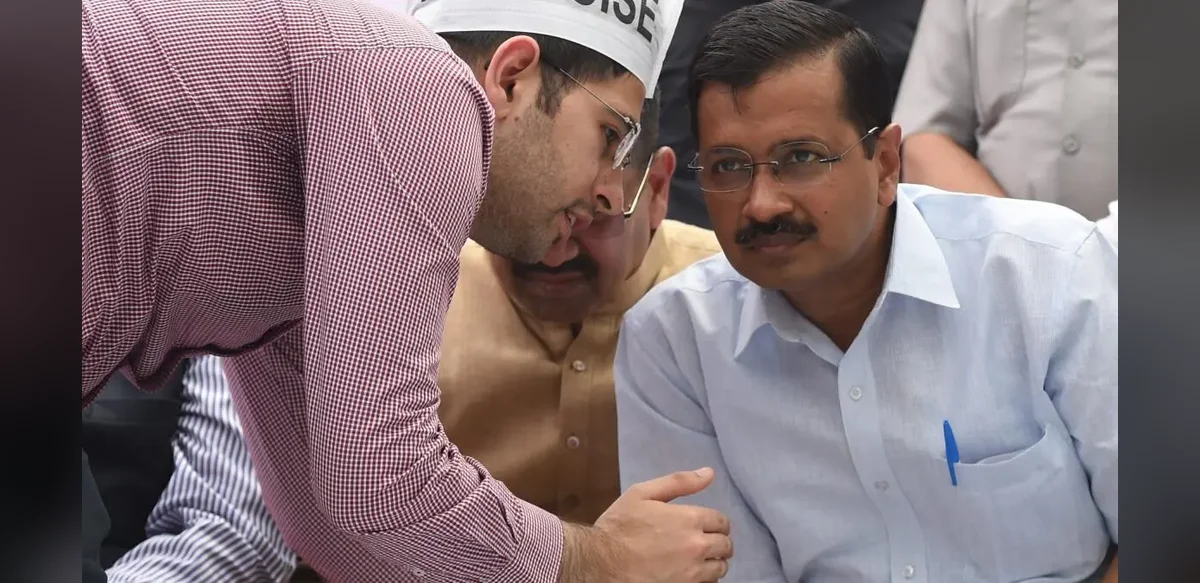
Seven out of ten Aam Aadmi Party (AAP) members in the Rajya Sabha, including prominent figures Raghav Chadha and Sandeep Pathak, have defected. These individuals held significant roles as strategists within the party. This mass departure exposes internal divisions and highlights the difficulties facing the AAP, established in November 2012, as it aims to recover from its defeat in the Delhi Assembly elections of February 2025.
The shift significantly weakens the AAP’s representation in Parliament. It may also impact the party’s position in Delhi, where it now sits in opposition after a decade in government, and in Punjab, the sole state under AAP control, with elections scheduled for 2027.
The defectors, in addition to Chadha and Pathak, include Ashok Mittal, Rajinder Gupta, Vikramjit Singh Sahney, Swati Maliwal, and Harbhajan Singh. The AAP retains three Rajya Sabha members: Sanjay Singh, who heads the party’s group in the Upper House, N.D. Gupta, and Balbir Singh Seechewal. In the Lok Sabha, it has Gurmeet Singh Meet Hayer, Malvinder Singh Kang, and Dr. Raj Kumar Chabbewal.
The MPs have joined the rival Bharatiya Janata Party (BJP), prompting AAP accusations that the BJP is employing tactics like enforcement agency pressures to lure opposition leaders. Party officials have labeled the defectors as opportunists seeking better prospects.
This event raises concerns about the AAP’s internal dynamics and its ability to maintain national relevance.
A senior AAP official stated, ‘We anticipated Raghav Chadha’s exit and prepared for it, along with a few others. This is a blow with seven MPs joining the BJP, but we will overcome it.’
The departures of Chadha and Pathak, both integral to organizational and electoral planning and seen as close to leader Arvind Kejriwal, fuel perceptions of centralized decision-making dominated by Kejriwal.
The key issue is why numerous former close associates have left or been ousted.
Chadha, a chartered accountant, connected with Kejriwal during the 2011 India Against Corruption movement and was a founding AAP member in 2012. He gained prominence in media debates and rose quickly, overseeing Punjab operations for the 2022 Assembly elections. His 2022 Rajya Sabha nomination was viewed as a reward linked to his ties with Kejriwal.
Pathak, previously an assistant professor at the Indian Institute of Technology Delhi, operated behind the scenes in Punjab, shaping strategy and structure ahead of the 2022 victory. His Rajya Sabha seat was recognition of his efforts, and he served as National General Secretary (Organisation).
Recently, Pathak reportedly felt marginalized after losing oversight of Punjab and Gujarat in a March 2025 reorganization. Manish Sisodia replaced him in Punjab, and Gopal Rai took over Gujarat.
Swati Maliwal’s case also reflects a fallout; once aligned with Kejriwal, she chaired the Delhi Commission for Women before her Rajya Sabha nomination. She was notably absent during Kejriwal’s March 21, 2024, arrest and later claimed assault by his aide Bibhav Kumar on May 13, 2024.
Political analyst Harjeshwar Pal Singh commented, ‘Arvind Kejriwal’s authoritarian approach and insecurity are evident, as he consistently sidelines or discards former allies.’

